Showing posts with label kashmir50. Show all posts

Thursday, July 4, 2019

Kashmir 50 years ago :: 12 :: Baltal Valley


http://www.bagchiblog.blogspot.com


The other day the local Hindi daily, Daink Bhaskar, published a fairly big picture – bigger than half a page – of the Baltal Valley in Kashmir. Baltal comes into prominence every year around this time as the Amarnath Yatra commences. This year it commenced on 1st July. Photographs have already appeared in the newspapers of ponies loaded with stores and provisions labouring uphill.

Baltal is one of the two options to approach the Amarnath Cave; the other, of course, is the traditional and age old Pahalgam-Chnadanwari route that, if I remember, is 24 miles in length and can be covered in three stages, each roughly eight miles apart. Baltal to Amarnath is a shorter route – of around only 6 or 7 miles. This route was opened a few years ago and has become very popular since it is shorter, though arduous, than the other route from Pahalgam. Those who are affluent can take a short hop in a helicopter to fulfill their needs of the faith.

The photograph that appeared in Dainik Bhaskar, however, broke my heart. What it showed was a sprawling tented settlement over what was once an alluring green grassy meadow. Obviously trees have been cut down for facility of movements of buses, taxis, private vehicles as also horses and ponies. Then of course there are flying horses like helicopters which have to land and need a substantial clear and levelled space for the purpose. The Valley was narrow with mountains on practically all sides covered with pines. All that seems to have gone!

Fifty years ago it was not so. I remember I came across Baltal Valley while travelling to Ladakh in 1968 in an Army jeep that was part of a huge convoy. The jeep stopped on the Srinagar-Leh highway as my senior, a telecom engineer had some checking job to be done at the small Signals outfit that was stationed here at Baltal. As I got off the jeep and saw the incredibly beautiful little valley with green meadows and pine-covered hills I was captivated by it. The narrow valley was surrounded by tall mountains; some even had snow on their peaks. It was a delightful sight.

My Director and I walked out into the Valley. Three men used to man the Signals unit and they explained to the Director the technicalities of the Unit and all that they required from the Indian Telegraphs. While having tea with them we came to know that Amarnath Cave was only about 8 miles away from this spot. But the climb was difficult and only the toughest of the Army lot have been able to go up to the shrine and return. The path was unchartered and treacherous at many places with crevices of unknown depths. There was a bungalow up there on one of the small hillocks where, the Army men said, Indira Gandhi was reported to have honeymooned way back in 1940s.

It must have been awfully beautiful place when Indira Gandhi came all the way here to have some quiet time for a newly-wedded life. There would have been very little disturbance. Surely there wouldn’t have been the groaning of trucks as they huffed and puffed their way up the mountain to the Zoji La pass like we saw and heard. Tranquil is what it must have been all the way.

The photograph that appeared in the newspaper was very distressing. I was distressed more when I checked Baltal out on the internet. There were images of tents and a mass of humanity that was supposed to be stabled in them, scores of vehicles, ponies and horses. Grass was notably absent from the ground. The meadow was simply gone. This was total destruction of a beautiful, thriving valley with greenery all around. This is the kind of environmental destruction that is wrought by our unchecked and unbridled religious tourism.

Time was when pilgrims used to come only in thousands. Now they come in hundreds of thousands. What is more, the Shrine Board that looks after the pilgrims and makes arrangements for their stay, etc. and takes care of the Amarnath shrine, invites more and more pilgrims every year. No gainsaying the fact that greater the numbers more severe will be the environmental degradation. But none cares although taking care of the environment is one of the imperatives of the government.

This is happening all around the country – whether it is Kashmir or Kerala. The grip of the religion that was pretty loose in our case is slowly tightening. That may not be a bad thing by itself but that should not be at the cost of Nature. We destroy the environment at our own peril. Already the signs of the deteriorating environment have started presenting themselves in our country as also elsewhere. Unless we cry a halt to it immediately we put at risk the very existence of life on this beautiful and benign planet of ours. More importantly, religious activism will not be able to keep us safe and secure.


*Photo from internet

Tuesday, April 30, 2019

Kashmir 50 years ago :: 11 :: Tulips and Daffodils

http://www.bagchiblog.blogspot.com


We were assembled at my place, around four or five of us on a Sunday. My boss was also there, as were my friends from the local government. Talking of this and that we landed on the topic of flowers. It was the month of July and the Mughal gardens of Srinagar were blooming to their glory. They were a riot of colours. In the midst of the conversation on flowers somebody happened to say that surprisingly though Kashmir had temperate-like climate yet it did not have the exotic flowers like tulips and daffodils.

I butted in and said tulips were very much there, though of indifferent genus. I had seen them in the flower beds of the Anantnag Circuit House. I had found them somewhat of emaciated and stunted, not like the tulips of Netherlands I had seen in photographs – large and well-fed, so to say. Obviously the Netherlands flowers, exported as they were even then, were rich in nutrients and the very look of them suggested that they were very well taken care of. Even the tulips that were grown in my compound were like the ones of Anantnag Circuit House. They looked like the country cousins of the ones grown in Netherlands and yet I never discouraged the gardener from spending his precious efforts from tending them. He used to say that the quality of the seeds is what matters.

As for daffodils I had till then not seen any, i.e. I did not know how they looked like. Perhaps it was a very common spring flower in the West or was not photogenic enough. Or perhaps it was not considered exotic enough. Tulips were considered romantic and a young man would go out of the way to procure a tulip bunch to gift to his sweetheart. There was no such romantic attribute attached with daffodils. Their fame originated from William Wordsworth’s poem “I wandered lonely as a cloud”, perhaps the most famous poetic composition in English language.

When daffodils were mentioned my boss said he had them in his small garden and said he would inform me when they started blooming. Some months later one morning I got a call from him saying that the daffodils were in bloom and that I should go over to his place to see them. Curious as I was, I trotted down to his place in the evening. As He showed me the flowers the words “oh, hell” escaped from my mouth. It was so disappointing to see them as I too had them in my yard, only neither the gardener knew their name and nor did I.

 I remember they were pale yellow and droopy, nothing like what I saw years later in Europe – nice and healthy, and bright golden yellow. On the fields near Kukenhoff, near Brussels, they were growing wild and, yes, they were “dancing in the breeze”, as Wordsworth saw them. Mesmerising as they were, one felt like getting a handful of them but in Europe flowers blooming in the wild are not plucked; they are allowed to bloom and wither.

Curiously, none ever mentioned narcissus as it was seen in profusion in Kashmir growing wild. Known by a more exotic name in Urdu, that is Nargis, it has its own admirers. They are off-white in colour with yellow petals in the centre. They are deliciously fragrant to make any woman of sense happy. Their genus is the same as daffodils; some even say that while daffodils are male narcissusi are females.

All that was more than 50 years ago. Now Srinagar boasts of a massive tulip garden below the Zabarvan Hills along the Dal Lake that offers colourful  flowers  in a 30 hectares garden. Curiously, the garden came up during the height of militancy, giving a good turn to Kashmiri tourism - one very rare positive from the violence of militancy. The garden has 1.5 million plants and 48 species of flowers. Every year something new is added and flowers like daffodils, narcissusi, hyacinths, etc. are planted to provide an ornamental appearance to the garden. This is one asset that is going to pay for itself and Kashmir Tourism couldn’t be happier about it.

*Photo from internet


Sunday, January 27, 2019

Kashmir 50 years ago :: 8 ;; Enchanting North Kashmir


http://www.bagchiblog.blogspot.com

One cold morning I received a telegram (yes, telegrams were used back then for speedy communication) that a village post office up in the mountains had caught fire and everything including cash and mail had been lost. As the amount involved was substantial the matter had to be investigated and quickly. Worse, it was I who  had to carry out the inquiry.

The place was located high up in the mountains of North Kashmir beyond Kupwara. The information received suggested that the hills hosting the office overlooked the Lolab Valleyand was getting steady snow falls. I was aware of the area having visited Kupwara and Lolab Valley several times. Both of them are places of exquisite natural beauty but Lolab Valley had a special distinction of hosting a secular Hindu clairvoyant in the midst of an overwhelming Muslim population.

Next morning with a couple of inspectors I set out for the place called Kalaroos. Proceeding via Sopore and Kupwara, we had our official vehicle parked at a place that was a kind of a pass between two ranges separating Kashmir Valley from Lolab Valley. The road to Kalaroos took off from the pass. Kalaroos was three miles up that road and the vehicle could not have made it as the road had a thick layer of snow on it.

Never have I had the occasion to negotiate such a torturous three miles as the one that I did with my junior colleagues that day. We had to climb a few hundred feet, maybe a couple og thousand, along the pretty wide road that was completely snowed under. Although it was a delightful day with bright sunshine and a bracing cold breeze blowing down the surrounding pine-covered mountains, the road was under ankle-deep of freshly-fallen snow. Walking on the snow is difficult but the effort gets more toilsome if one has to walk in ankle-deep soft and yielding snow with the feet sinking in with every step. Every time one has to pull one’s feet out to take a fresh step. It gets more laborious if one has to do so while walking uphill. Never an athletic type, for me it was nightmarish. The only thing that kept me going was the compelling beauty of the surroundings. Down below was the freshest and the whitest of snow-white snows with the mountain sides and the precipitous valleys dressed in bright green of the ever-green conifers and under the lapis lazuli blues of the sky were, again, snow-capped mountain tops gleaming in the bright February sun. It was ethereal – almost spiritual. Every bend of the road would open up a new vista – a panorama so arresting that one wouldn’t be human unless one stopped and beheld it.

We huffed and puffed our way up and eventually reached the village. It was located in a clearing and I noticed three chairs placed in the sun with a tray with about a couple of dozen shelled eggs. Dog-tired as I was, I made a beeline for one of the chairs and literally collapsed into it. Recovering after a while as I took in the landscape I was amazed to notice an uncanny resemblance with the paintings I had come across of the Holy Land. The thatched rundown houses, the green pines in the background and the tall, extraordinarily fair, heavily bearded handsome men with pronounced Semitic facial features, draped in long ochre coloured clothes, it all appeared to me to be straight out of the Biblical times. The only distinguishing feature was the Islamic cap that some of the villagers had placed on their heads. The whole thing was stunning and picturesque and made the tiring trip memorable. Hospitable as all Kashmiris are, they served us delightfully hot kahawa, the Kashmiri tea and insisted on us to partake the boiled eggs.

After finishing off the work and consuming more than my normal quota of eggs to subdue my ravenous appetite I tore myself away from that incredible setting. Climbing down the mountain was not so difficult. As the afternoon sun was dipping down rapidly we decided to stop for the night at Chandigam in Lolab Valley. The place had a rest house which was said to have been built for the Late Indira Gandhi (This was the second rest house I had come across where she was reported to have sojourned). It had hot and cold running water, a luxury not available in those days in most of the rest houses in Kashmir, and had a couple of extra bed rooms. It was situated at an elevation and hence commanded a panoramic view of the narrow valley in front, dominated by a lone poplar, and the thickly forested hills on its sides. It was a lush green little valley of indescribable beauty, mostly uncluttered by human interventions. The place was known for its colourful chicken which kept darting across the road. Having seen them on the way I didn’t have the heart to eat such beautiful birds.

The hill that separated Kupwara from Lolab Valley was thickly forested with walnut trees. In the midst of this forest of walnuts was a resident clairvoyant who was popularly known as Baba. A religious recluse and a Hindu, he was known for being able to look into the future of whoever cared to go and ask him to do so. Having nothing much to do in the evening, we trooped into his lair. A fire was raging in a pit and around half a dozen devotees, all Muslims, were sitting closest to the entrance facing the Baba on the other side of the fire. As we entered the simple and austere enclosure Baba noticed us and asked us to be seated next to the fire. After some small talk about the Baba and his fame in the surrounding areas, one of the devotees told us the story of a Pakistani Lt. Colonel who had stumbled into Baba’s presence.

Lolab Valley was overrun by the Pakistani Army during the 1965 war. The Pakistani Army had also captured the hill where Baba was in residence. They used the top of the hill to fire at the garrison at Kupwara. Keen to clear the hill of all enemies, a Lt. Col. of Pakistani Army came to the Baba’s lair. As soon as Baba saw the officer he told him to get back home as his daughter was seriously sick. Even before he could recover from the shock a messenger arrived to tell the Lt. Col. to report to his headquarters. The officer left, organising a detachment to maintain a guard on the recluse. He did not return for a few days. After a week or so the guards were withdrawn and the Baba was told the daughter of the Lt. Col. had died.

One does not know whether the recluse is alive or not but I have had occasion to hear some local army officers in Bhopal who had had similar encounters with the Baba. Apparently, he was a kind of an institution; his was a much-visited lair by all those who happened to visit Chandigam.

It was only around four years after the 1965 war with Pakistan yet I had visited Kupwara and Chandigam several times all by myself travelling in my own car. Never was there an unpleasant incident. Later, during the twenty-odd years of militancy, however, these two areas became popular with infiltrators from across the LoC (the border with PoK) Now, it seems, the things have quietened down and the Kashmir Government is thinking of opening them up for tourism. One can only wish it Godspeed. Let the tourists enjoy the nature’s bounty in North Kashmir. After all, there is more to Kashmir than just Gulmarg and Pahalgam.

*Photo from internet


Sunday, January 13, 2019

Kashmir 50 years ago :: 7 :: Ladakh (Part 3)


http://www.bagchiblog.blogspot.com


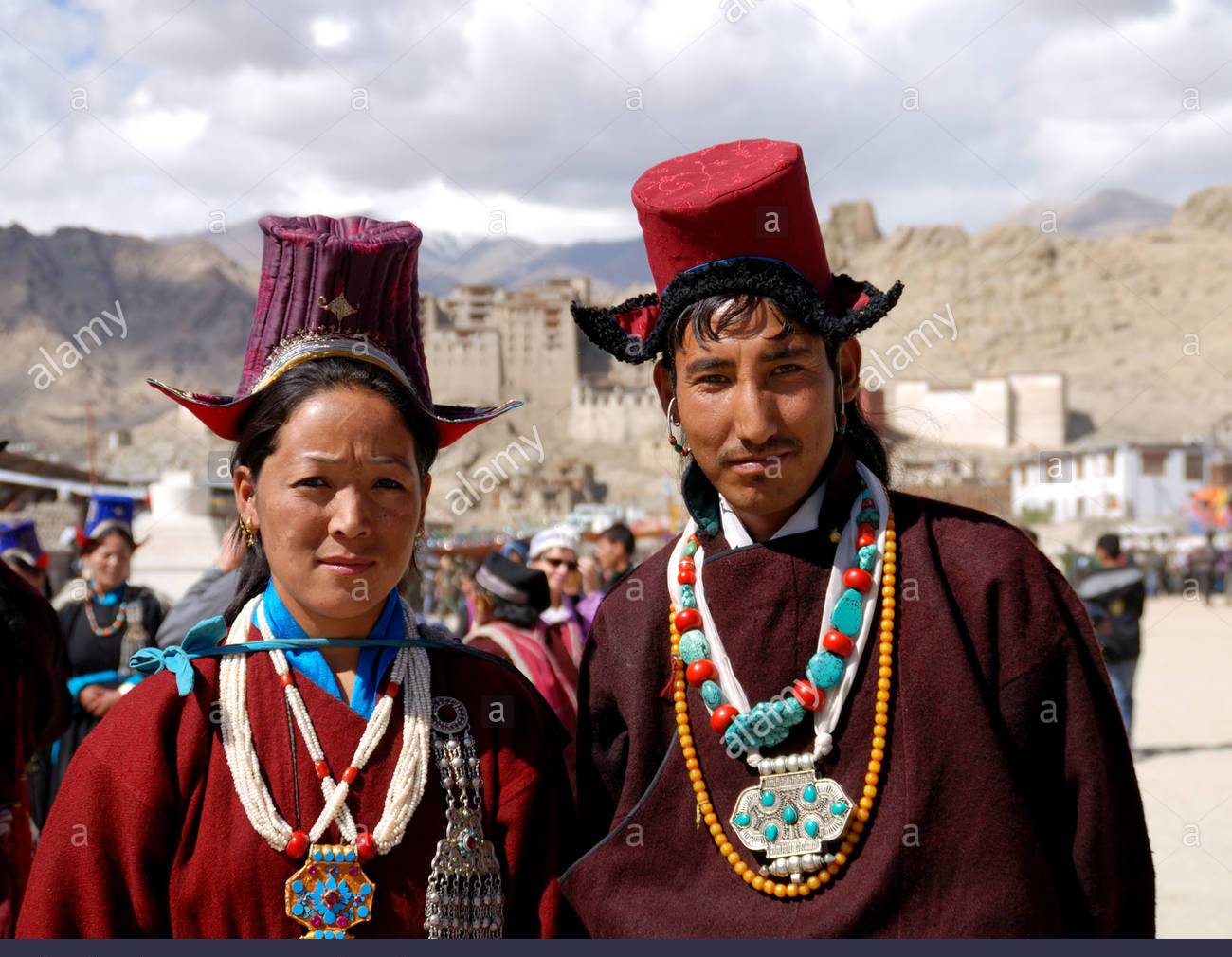
A Ladakhi couple
The landscape from the verandah of the Signals Mess in Leh was beautiful though it was stark and devoid of greenery. It was, after all, the Indus Valley; River Indus flows by its side The jagged peaks of distant mountains formed the background from where one could see some white valleys and occasionally a snow covered peak. It was September and at the rarified elevation of more than 11000 ft it was hot during the day and pretty cool at night. In the foreground was the huge open dust-laden space with a few occasional structures. The wind that was virtually devoid of moisture blew across it persistently making the body dry and my lips were so badly cracked that it became painful to even smile. The Army personnel used a kind of lip salve to prevent them from severe cracking.

 Despite this minor inconvenience Leh physically was a pretty site with its rugged landscape that appeared to me somewhat macho and its men and women in their colourful Ladakhi tunics with thier peculiar Ladakhi head gear. One cannot fail to mention the heavy ethnic jewelry that adorns almost every Ladakhi woman. Perhaps in the stark and somewhat dreary surroundings the colourful costumes and heavy ornaments break the monotony for the locals.

Next morning we were to leave for Srinagar but only after visiting Hemis Monastery. Hamis is about 20-odd miles away from Leh. On the way we stopped at a superstitious stop. It is said that an army convoy driver was asked to halt by somebody but he did not stop and later he met with an accident. Since then, it seems whichever army vehicle did not stop for a couple of minutes at that stop it met with an accident.  Hence, the superstitious stop.

Hemis is a mountain-side monastery and one has to climb up and down. What were striking were the huge images that were painted in bright colours. The monastery is of 17th Century and one wondered whether the statues that were installed there were painted like they are now. Apart from the monks there were hardly any non-Buddhists around. Now, of course, it is different; Hemis has become a thriving tourist site, as indeed Leh is. Flights from major Indian cities have flights to Leh and there are some international destinations also that are served to and from Leh. Hemis has an eponymously named annual festival too.

From Hemis we drove down for sometime before we hit the road
Ladakhi women prparing for a dance
that was euphemistically called a highway for Srinagar. We were late and, it had become obvious we would have had to stop over at Kargil. We were at Fotula when the sun had already sunk behind the mountains and a chance glance gave me an opportunity to shoot a “picture of the year” had I had a camera. It was a captivating sight; the dazzling full moon rising over the mountains with a pyramidal peak just by its side and the silhouettes of mountains in the foreground. It was an amazing sight, like of which those who take the aerial route to Leh tend to miss.

Another drive of more than a couple of hours and we crossed Mulbek. Near Kargil we were at a higher elevation and its cantonment lay sprawled below us like a medieval army laying a siege. The bright moonlight gave away most of the features. We drove around a hill and descended to the cantonment and were lodged in the Signals Mess.

Next morning sitting out on the lawn with a captain for coffee after breakdast I happened to notice the mountain behind him which seemed to dominate the cantonment and the surrounding areas. The captain told me that it was known by its elevation that was 13620 ft and was in Pakistani occupation and hence the enemy was at an advantage. It could take pot shots on people down below, even us as we sipped our coffee. He said it was captured during the war of 1965 and the Pakistanis were dislodged from the peak but under the Tashkent Agreement Indians had to give it back to the Pakistanis.

 The captain continued and said that the officer who had won it during the operations shed copious tears for many of his friends and collegues he lost in capturing the peak. Strange are the ways of diplomacy. The India-Pakistan conflict has always been victim of Cold War politics and interference by Big Powers. In this case it was the now-defunct USSR which brokered the peace, insisted on status quo ante. The Indians had to withdraw from the areas they had won in the war that was not of their making and, more importantly, most of them legitimately belonged to India but illegally occupied by Pakistan. Such is the price that we had to pay for being weak and infirm and dependent on the help of others who were basically unscrupulous. Mercifully, Point 13620 was recaptured during the 1971 War with Pakistan and it has remained with India since then.

We left for Srinagar the next morning. I was somehat happy to get away from this arid vastness of Ladakh where people surprisingly have chosen to set up their homes. Though the landscape was spectacular with colours changing as the sun moved from horizon to horizon yet it was too dry for my comfort. Nonetheless, I felt that whatever views and images that I happened to decord in my “hard disk” would remain as parts of me right through my lifetime. I, therefore, feel that those who fly in and out of Leh miss so much of the country which by far is far too deserving of the long haul of a journey by road.

Soon we left the arid Ladakh behind and the green hills after Zojila came in view. As we descended down the mountain road the greens of the Baltal valley seemed to soothe my nerves.

(The 3- part write-up on Ladakh concluded)

*Photos from internet


Thursday, December 13, 2018

Kashmir 50 years ago :: 4 :: A feast to remember


http://www.bagchiblog.blogspot.com

Kashmiri pulao

A few days after I arrived in Srinagar in June 1968 on my posting I was out walking in the evening on the Residency Road. I had hardly walked a few steps when I heard my name being called out from the other side of the road. Wondering who it could be calling out to me I stopped to look around. Yes, there he was on the other side of the road frantically gesturing to me to cross over. I did that to go and meet Shafi Bakshi and his beautiful wife Naseem. They too were having a stroll on Residency Road when they spotted me.

The Bakshis were family friends in Bhopal. They were friendly with each member of my family. Shafi was a nephew of Bakshi Ghulam Mohammed, the former chief minister of Jammu and Kashmir and was in charge of their Bhopal outlet of Fairdeal Motors, an outfit I have not heard about for a long time now. Shafi told me that he hollered for me as there was, among other things, a dinner at his place and he and Naseem wanted me to attend. Naseem asked me not to miss it as it was going to be something special.

If I recall Bakshis were four brothers and each had a bungalow. It was a beautiful complex with four spacious bungalows in, if I recall, Badami Bagh with almost a quadrangle of open space in the middle. As a ”special” dinner was in the offing the place was decked up. As I went into the enclosure it was Shafi who met me and took me to his father and then I was taken to Naseem who was supposed to look after me.

A Bakshi dinner in Srinagar had to be a political affair. I, of course, did not know any of them. What struck me was that the then current chief minister Ghulam Mohammed Sadiq was missing. Apparently, he was from a group that was not aligned to Bakshi. Anyway, that was none of my business. What was important for me at that point of time was the food – Kashmiri food, the best of it that money couldn’t buy, perhaps, even in Srinagar.

Kashmiri food traditionally is rice and meat based. The Kashmir Valley grows rice and it has become over centuries the staple of Kashmiris. It is said that in their feasts called Wazwan, the multi-course affair, there is nothing other than meats (of lamb, chicken, beef) but no fish. It is also said that serving lentils in such a feast is nothing short of sacrilege. As meats predominate the cuisine, the use of various kinds of spices with cans of ghee is necessary. This makes the food very rich.

 Naseem was standing by a table laden with entry dishes that were being heated by a flame below. She said there were eight kinds of pulaos in those entry dishes. She chose for me what she thought was the best, served a huge quantity to me. I could smell saffron and as the lid was taken off its aroma wafted all around.

 Then there were other tables loaded with Kashmiri delicacies of mutton and chicken. I remember the famed Goshtaba – the meat-ball curry, yakhni, the mutton curry that is made with yogurt and, of course, rogan josh. What was out of this world was tabakhmaz (Kashmiri Hindus call it qabragah) which was a dry fried dish of ribs of a goat. I wouldn’t know how it was cooked. Naseem told me it took quite a lot of time. It was delectable. In fact Kashmiri mutton dishes are cooked with a lot of patience. Goshtaba, I recall needs mutton to be beaten into kind of a paste for making balls which are then further processed with myriad spices to create the fascinating dish.

Naseem was a very good hostess and she egged me on to eat as she kept serving me king-sized helpings of pulao and meats. She filled me up so much that I had to refuse the sweet of which there were many kinds and bid good bye to her and Shafi. I came back home with my midriff bursting at the seams with lots of pulao and meat. I have always been a small eater but that evening I was literally stuffed to the gills.

I slept off with a heavy stomach. Next morning I skipped breakfast as I didn’t feel like taking it. I did not feel hungry at lunch time too. The stuff at Shafi’s was so rich that enzymes in my metabolic system proved unequal to its demands.

*Photo from internet


Thursday, November 29, 2018

Kashmir 50 years ago :: 3 :: A trip to Uri


http://www.bagchiblog.blogspot.com


I was thinking of proceeding to Uri as the office there was due for inspection when Ghulam Mohammed dropped in. He used to be the staff car driver of the Director’s office. I used to think that he was somewhat stand-offish. He, however, became very attached to me after I got his pension authorization in three days time from Kapurthala – the seat of our audit office. More about him later.

 He asked me whether I was thinking of going out of station, if so, he said, he would come along to drive my car. In those days we at the field level had no official vehicle. We were left to our own devices – either one’s own vehicle or use of public transport. Since Ghulam offered to come with me I thought he would be a great help. I rushed the plan as we had to take Inner Line permits for everyone, including Ghulam, a thorough-bred Kashmiri. to enter Uri. It was not open to the public.

Along with Gjulam and Ramesh, my PA, we left for Uri one very fine morning. It was a well built road and the journey was pretty smooth. As we reached the check point I had to stop the vehicle. I kept it at the extreme left from where I could see the man waving the flag for vehicles to move on. Soon I found the man looking at me and waving his flag. I started off and was cruising at a decent speed. Even despite the noise of the car we could hear the Jhelum River going down a gorge in frothy turbulence. Soon we reached Chandanwari and got into the guest house. Seeing a garage right in front with its gate open invitingly I put the car in and the PA tried to shut the heavy doors but couldn’t as there was nothing to hold them together.

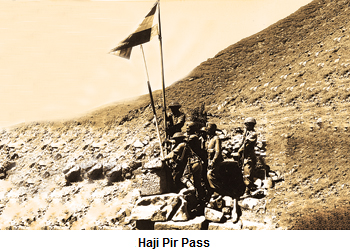
Having refreshed ourselves, all three of us walked to the office. It was around one kilometer away and the road was along the river. After about 500 metres there was a bend to the left and right in front was the Haji Peer Pass at a fairly high elevation. I understand it is more than 8000 ft high.  Hajo Peer, as is well known, was captured by Indian force at great cost of lives in rge 1965 War but was returned to Pakistan under the Tashkent Agreement. We had won back our own territory which was illegally seized by Pakistan, hence where was the question of returning it; but such are the inexplicable ways of the politicians.

Uri at one time was important as it connected Kashmir through the Jhelum Valley Road to Rawalpindi. It also connected Kashmir with Poonch. Nonetheless, it was like a one-horse town. Across the river the mountains were in illegal occupation of Pakistan.

After about three hours I finished the inspection and we commenced our walk back to the Chandanwri rest house. It was pleasantly cool and one felt like walking. Arriving at the rest house I checked the car and was happy to find it safely in its shelter.

Next morning we commenced our drive back for Srinagar. This time it was Ghulam who was driving. It was uneventful until we came close to the checkpost around 50 yards from which two jawans vigorously waved us down. They led us close to the checkpost which, in fact was functioning from a tent. They said they looked for my car all through the previous day; they even had gone to neighbouring villages as they couldn’t locate it in Uri. They said I had gone past the check post without getting the necessary clearance. They asked us to wait till the Captain who was manning the post was free.

While waiting outside the checkpost I surveyed the surroundings. Kashmir’s beauty was really unmatched. In the midst of this beauty there was this ugliness of the guards who were manning the post. They were rough and harsh with the passengers in a bus who apparently did not have the permit to go out of Uri. Some of them were pulled out of the bus roughly, thrashed and were, quite clearly, left high and dry. The army was Indian and it was also of the Kashmiris and hence perhaps those who defaulted could be treated more sensitively. But there was a flip side. The Army had to to be rough as this was also the route for infiltration from Pakistan.

Soon we were called in. As I entered the Captain, who was a young handsome Sikh asked where we had disappeared in Uri. He also said that his boys went all over but couldn’t find the car – a prominent looking car of flashy red colour. I handed to him the permits and gave our identities saying that I was in Uri on Central government business and that the car was in the garage of Chandanwari rest house where we spent the night. He seemed to be amazed and perhaps a trifle foxed. He asked again about the car and whether the garage was locked. I gave him the facts. It was then that he seemed to go ballistic and let loose a barrage of choicest Punjabi expletives directed at his soldiers.

While he asked me to push off he held back the guards for perhaps some more slamming in the privacy of his tent.It was an anticlimax for the Army boys who perhaps never expected a dressing down and that the table would be turned on them. Of course, we were not privy to how actually things panned out for them. 

*Photo from internet


Sunday, November 18, 2018

Kashmir 50 years ago :: 2 :: Below Peer Panjal


http://www.bagchiblog.blogspot.com

Aharbal Falls

In early October I had to go to Anantnag. None, except the stenographer, accompanied me. An inspector in-charge of the sub-division, one Ganjoo, came from Pulwama to assist me. After a three day-stay when it was time to get back to Srinagar Ganjoo asked me why not travel along the Peer Panjal and peep into Kulgam, Pulwama and Shopian before  returning to Srinagar. I thought it was a good suggestion. I would not only be able to look at larger numbers of field offices, I would also be able to see these sizable towns. Shopian, of course, I had visited in 1957 when we had come over to the Valley along with the family. I still have a photograph that my late brother had taken with his then newly bought Agfa camera. He was a mere probationer then – and now he is dead and gone after serving 34 years in the government and another 20 odd years with an NGO run by Dr Karan Singh.

After informing my office about my new destinations Ganjoo and I started off in my car towards Kulgam. The place was around 20 kms from Anantnag (also named Islamabad by Kashmiri Muslims). We had, however, to cross the Jhelum and move closer to the Peer Panjals and then head north. The road was, as was usual in Kashmir those days, very picturesque, sometime plain and at others undulating, generally lush green. Evening fell as we got closer to Kulgam. Ganjoo had already made arrangements for our stay in a rest house which was not far from a stream which I gather is known as Vashaw beyond which were the foothills of Peer Panjal. In the gathering dusk these hills seemed to be intimidating and brooding over Kulgam.

Next morning after completing my official chores as I was having tea back in the rest house and contemplating about the return journey Ganjoo asked me whether I would like to take a shot at Aharbal Falls. I had heard of Aharbal Falls in 1957 but we could not make it convenient to visit it, Ganjoo said it was very close – across the River over which there was no bridge. I was reluctant to go as I did not want the car to wade through the water. But he convinced me saying the river had very little water and he offered to go to the midstream to direct me. Reluctantly I agreed. Ganjoo walked upto the midstream and showed me the water was as high as his uncle. I put the car on low gear and drove into the river. It wasn’t exactly a cake walk. The Heralds used to be low slung three box cars and hence lots of stones and pebbled hit its bottom. But I made it and then we drove on green grass close to where the fall was hitting the ground

It was a fantastic pastoral scene I was witness to as we crept as close as we cold to the fall. The mossy dark hills from top of which the water was gushing out in a cascade were spectacular in the evening sun. Somewhere in the distance there was a white capped snow-covered peak shining in the sunshine below turquoise blue sky and down below my red Herald with its beautiful sharp lines looked stunning on the grassy green ground with the white sheep grazing nonchalantly nearby. We pottered around for some time and rued the absence of a camera to capture the beautiful sights. The next best thing I could do was to internalize the whole scene so that the visuals remained etched In my memory. The Aharbal Fall was of impressive proportions – the water cascades down about 150 ft in torrent making a big splash on the ground the surroundings of which were as beautiful as nature could make them. A fantastic sight!

We returned to the rest house just as dusk was falling. I had no words to thank Ganjoo for initiating this remarkable outing. He had endeared himself to me and so I asked him to accompany me. He used to have his family at Srinagar and he agreed to take the trip back home with me.

Our next halt was Pulwama which was about 50 Kilometres away. The road was as everywhere in Kashmir picturesque. What was more, one drove literally under the shadows of Peer Panjal.  Kashmir was yet to develop and hence vehicular traffic was negligible. It was a pleasure to drive on generally good roads. As one didn’t have to bother about the traffic one could take in the natural beauty on two sides.

Pulwama town until then had only a municipal committee and the surroundings offered little by way of attraction for a visitor. As the town was small our outfit too was small. As I was looking through the documents a call came through from my boss Director P&T Jammu  & Kashmir. He wanted some Delicious apples which Pulwama was famous for. In fact, Pulwama was known for its apples and was also known as the rice bowl of the state.

Our people told us about the best Delicious grower and we headed towards him. This was my first ever visit to an apple orchard and it was fascinating. The sweet fragrance of apples permeated the orchard and the red apples hanging from branches in bunches looked beautiful. The grower accompanied us and took us to the tree which produces the best apples, and would you believe, he charged us just Rs. 20 for 5 Kgs of apples?

I understand that old apple trees have since been axed as their productivity declined with age. The district now is strongly into growing high-density apple trees as suggested by Italian collaborators who claim that the productivity would improve several times over. The beginnings have been promising. Perhaps, in a few years time the state will flood the entire country with apples grown by the high-density Italian method.

We covered the 20 kilometres to Shopian in less than an hour. It is at a higher elevation and hence colder than Pulwama or Kulgam. It is a historical town in as much as it was the entry point into Kashmir via what was known as the Mogul Road which Emperor Akbar is supposed to have taken to visit Kashmir. This road fell into disuse once the Banihal Cart Road gained in importance as the only access to the Valley. The Mogul Road is now being revived so that another route becomes available relatively free from landslides and other obstructions.

 A night’s stop and we hit the road again, this time for Srinagar. I covered Kulgam, Pulwama and Shopian, the three places which have currently become very turbulent. Militants – foreign or domestic – frequently attack the Police or the policemen. Kidnappings and snatching of arms from the security establishments are a matter of daily occurrence. Instigated by the so-called Separatists, school-going children come out in large numbers to pelt rocks at the security forces. The atmosphere is vitiated and the area has been converted into killing fields. Killings of terrorists, security establishments or the common people continue unabated. One does not know when and where it will lead Kashmir to. For an outsider the killings look meaningless as nothing is going to be gained by bloodshed - certainly, not the heavenly peace and tranquility that I witnessed in these areas half a century ago.

*Photo from internet

Saturday, November 10, 2018

Kashmir 50 years ago :: 1 :: Diwali at Prang


http://www.bagchiblog.blogspot.com


Diwali was celebrated the other day with lavish purchases but muted celebratory fireworks. The subdued celebrations were due to the terrible atmospheric pollution that prevails in Delhi. The air there has become virtually un-breathable, visibility reduced to a few hundred metres with the sun making a disappearing act.

My mind, more agile than my body, swiftly travelled down the broad memory lane, latching on promptly to this thread of Diwali and traversed half a century to 1968 when I was posted in Srinagar. It was a pleasant Diwali morning and surprisingly very cold. It was I think 20th October but it was very cold rather prematurely. It was a holiday and I had no worries of dressing formally for office. It was going to be my first winter in Kashmir anyway. Like a good child I donned my woollen socks and a woollen pullover and, after breakfast, went straight under the quilts. The glazed windows of my bed room on two sides were tightly shut yet the cold breeze seemed to penetrate them without any let or hindrance. Lying on the bed I could see the canopies of the trees in the yard swaying in a rather strong breeze. I was looking out at them through the glazed windows as random thoughts flitted through my mind.

 I was lost in my thoughts so completely that sounds of steps on the wooden staircase outside the tightly shut door shook me and out of my reverie. The door opened and in walked Hindal Tyyabji (IAS 1965), a very good friend who was with the J&K Government. He was four batches junior to me. He wanted me to get up and get dressed as he wanted to picnic with some of our common friends at Prang a few miles away. I pleaded with him that it was too cold and, besides I was short of cash. He would have none of it and said whatever cash I had could be used for buying gas for my vehicle - a 1962 Standard Herald. Knowing that he had legged it all the way from his house in Jawahar Nagar about 3 or 4 miles away I didn’t have the heart to say a stern “no” to him.

 Hindal used to be a great organizer. He had everything mapped up in his mind and shot off to buy provisions. In those days Srinagar was different and far more tolerant than it is today. Everything used to be available then without any reservation – from pork sausages to other non-vegetarian tinned stuff and liquor. Hindal went and bought a handful of things and by the time he came back two other friends, Udipto Ghosh, again of the J&K Government, an IAS probationer (now unfortunately no more) and Jyoti Mathur, Dy. Accountant General with the Accountant General of J&K, had also turned up. Apparently it was a well conceived plan and Hindal seemed to have planned the entire outing in his mind and had informed them before he came to me.

I suppose, by !! AM we were on our way to Prang which was around 30 Kms. away in the district of Ganderbal. Being a holiday, there was not much of traffic. We made it well under an hour. Hindal had already decided on the place where we would halt by the side of the River Sindh. We stopped next to a grassy plot and Hindal quickly moved towards the boot, took the beer bottles out and went across the road to the river bank to submerge them in the deliciously cold water taking care that they did not literally go down the river with its flow. Others got busy in making arrangements for all of us to relax.

Fifty years ago Kashmir used to be virtually a paradise and the landscape, whichever direction one happened to look, used to be captivating. Population was low and vehicular traffic used to be scarce, more so, on the highways. A stray omnibus or two, seemingly losing their way, would occasionally appear on the scene messing up the view. Every turn on the road would offer a new vista, more beautiful than the one that just went by. Greenery and, flowing streams by the sides of the roads shrouded under the canopy of weeping willows took the breath away.

I remember when once I was going to Anantnag I came across, after Pampore, an astonishing scene. The fields were yellow with the mustard crop, above them were the green trees at an elevation and still further up were the blue hills capped by the snow-clad white mountains. That was not all; all these were stacked up one over the other as if arranged mindfully, as if knowing that the firmament above was azure blue. It was such a dramatic and amazing sight that I stopped my vehicle and parked it on the roadside to take in the incredible view. I think I remember the scene so well even after half a century because I stopped and took it all in to carry it with me for the years that have gone by and perhaps I will carry it during the years that are yet to come.

Kashmir was different then on another count. There was no militancy although 1968 was only three years after the 1965 Pakistan choreographed war. There were, however, some elements who were against the presence of Indians and the Indian Army. Their opposition was mostly manifested by writings on the walls. There was no violence. I recall having once walked back past a winter midnight from Mathur’s house in Jawahar Nagar without any mishap. Only some stray dogs kept barking at me.

Prang was supposed to be a remarkably beautiful place on the way to Sonmarg. It was said that it was a nature-lovers’ delight. I have always held that hills with water bodies, together, make nature exceedingly beautiful. Only we, humans, should know how to maintain them in their pristine state. The place Hindal had chosen offered a delightful view of the river and the fields beyond with the mountains seemingly brooding over them. One couldn’t really take one’s eyes off the sight as it was so enchanting and fascinating. In those unmatched surroundings we gossiped, snacked on what Hindal had bought over bottles of ice-cold beer, thanks to the River Sindh,

After lounging around for a few hours we made our way back to Srinagar. It was a day well spent, out in the lap of nature at a place where nature could be ravishingly beautiful. Thanks to Hindal, it was a terrific Diwali – and that too in Kashmir.


*Photo from internet

DISAPPEARING FREEDOM OF EXPRESSION

http://www.bagchiblog.blogspot.com Rama Chandra Guha, free-thinker, author and historian Ram Chandra Guha, a free-thinker, author and...