Friday, January 26, 2018

Our Life, Our Times :: 14 :: Disputing Darwin's theory of evolution


http://www.bagchiblog.blogspot.com


Thank God the Junior HRD Minister has been ticked off by his senior colleague. He seemed to have become too big for his boots and indulged in making statements that were utter drivel. Satya Pal Singh was a late entrant in the Union Cabinet and was appointed the Minister of State in the Department of Human Resources Development. Before becoming an MP he was an Indian Police Service officer and had worked as Commissioner of Police, Mumbai. He had also worked as Commissioner at Pune and Nagpur, two big and problematic cities of the state of Maharashtra

To recount his brilliant findings, he had claimed that Darwin’s Theory of Evolution was all scientifically wrong. The claim that Man had evolved from apes was not proved as none has ever seen a monkey transforming into a human. “Since (the time) man is seen on earth he has always been man. Nobody, including our ancestors, in written  or oral (sic), said that they saw an ape turning into a man”.  Unfortunately, it was not very clearly reported about what his views were about man’s evolution. He, probably, was aiming at his own theory based on Vedic and/or Puranic theology.

He was, apparently, planning a seminar to prove that Charles Darwin was wrong and his theory should not be taught in schools and colleges. While making the statement he also claimed that he had acquired a degree of doctor of philosophy in Chemistry from the Delhi University and, therefore, he, presumably, thought he knew what he was talking about. Thankfully, he did not claim that he also cleared the Civil Services Examinations and qualified for the Indian Police Service which made him all the more eligible to reject Darwin’s theory of evolution that has been accepted by the scientific community over the last century and a half.

No wonder his statement evoked violent reactions from the scientists of the country. About 2000 scientists from major scientific institutions, such as Tata Institute of Fundamental Research, IIT Mumbai, Indian National Science Academy, National Academy of Sciences etc. condemned the minister’s remarks. “There is no scientific dispute about the basic facts of evolution”, they said. They also said that it would be a retrograde step to remove the theory of evolution from the curriculum of schools and colleges.

Mercifully, the senior minister Prakash Jawdekar squelched Singh’s plans well in time. Otherwise the latter would have got together some malleable and friendly scientific folk to propound some views contrarian to those of Darwin and made fools of themselves among the scientific community in India and abroad bringing bad name to Indian Science.

How could one ever think of contesting what Charles Darwin propounded in his Theories of Evolution and Natural Selection beats me. Darwin did what all he did by a laborious process. For instance, he went off, much against his father’s wishes, on a voyage in the early part of the 19th Century of around five years and meticulously collected his specimens of rocks and fossils from the coasts of South America, interested as he was in geology and natural sciences. Darwin is regarded as a giant of modern science, a naturalist to the core whose theories have been proved in modern times by several investigators in England and elsewhere. SP Singh, despite his Ph.D. in Chemistry, can stand nowhere near Darwin much less contest the latter’s pronouncements.

SP Singh’s views are in close proximity to those held in Islam. Best of educated Muslims, including Mansoor Ali Khan Pataudi, the Oxford educated late skipper of the Indian cricket team, reject Darwin’s theory. Pataudi had once said that Islam does not believe that Man had descended from monkeys and so he, too, couldn’t accept the proposition. They perhaps believe that everything in the universe, including Man was created by Allah.


The very comment of Singh that none has ever witnessed a monkey transforming into a man indicates he has not understood the scheme of things as Darwin saw and comprehended before theorizing about Evolution. Evolution, as the very word suggests, is not an instant process as Singh would like it to be. It is a slow and gradual process that has an indefinite future and may continue till eternity. The earth itself with all its components has evolved over millions or billions of years. Man, for example, in all probability, is not completely evolved yet and could continue to evolve and, with efflux of time, may become a creature far superior to what he is today. Who knows? Not you and I, nor SP Singh!   

Monday, January 22, 2018

Destinations :: Washington DC (1998)


http://www.bagchiblog.blogspot.com

Washington Monument
I had to cancel our hotel booking in Washington as a very old friend working with the US Diplomatic and Commercial Service insisted that we stayed with him. We had decided to travel by train as so far we had travelled mostly by air and cars. Amtrak was to take us straight to Washington from Cary in North Carolina. Amtrak is the only government subsidized passenger railway transportation service in the US.

 We were to catch a train leaving around noon. When our nephew took
Lincoln Memorial
us to the station we were overcome by disappointment. There wasn’t a soul at the station and the building appeared to be locked. Unlike in India, there was no jostling crowd and no tea or snacks sellers. A wicket gate led us to the platform which too was empty as if all the trains had departed and none was expected. As we waited here for the train, it soon pulled in around the appointed time. As it came to a stop an official, presumably the guard, checked our tickets and took us to the carriage we were to travel in. We were the only ones to embark from Cary. The
On the forecourt of Capito
whole process would not have taken more than two minutes and was facilitated by the absence of crowds like in India. Obviously most people fly or take to the highways and very few travel by trains. The railways in the US are in competition with both, the highways and the airlines.

The train was not particularly fast and took around six hours to reach Washington, a distance of less than 300 miles. There was another surprise at Washington. I was looking for my friend on the platform but didn’t find him. Then I realized all the passengers were heading towards an exit point where all those who had come to receive people were there in a big lounge. As we were going across to exit the station I heard my name being called out over
Korean War Veterans Museum
the public address system. That is how I got to meet my friend. In the US barring the passengers none is allowed in on platforms, a system that cannot, unfortunately, work in India. We facilitate non-passengers’ entry by providing for a platform ticket for them which was dirt cheap till only a few years ago. No wonder, crowds would jostle around for receiving or seeing-off their friends and tea and snacks establishments operate from the platform.

Kennedy Centre murals
This was a very old friend of mine. We were in middle school together around late 1940s, then at the high school and were also in the college together though in different streams. He then did his engineering and made way to Germany, later to Canada and finally to the US. Living in Bathesda, a very likable suburb of Washington DC located within the State of Maryland, his house was on a hillside and was built along the incline. Very hospitable, we had a great reunion after many years.

At the Lincoln Memorial with a friend
Washington DC, the capital of the world’s most powerful country, is surrounded by the states of Maryland and Virginia both of which donated lands for creation of a national Capital District along the Potomac River. Normally known as “DC”, i.e, the District of Columbia, on which the US Congress has exclusive jurisdiction. The city is named after President George Washington and Columbia is said to be the poetic name of the US – hence Washington DC.

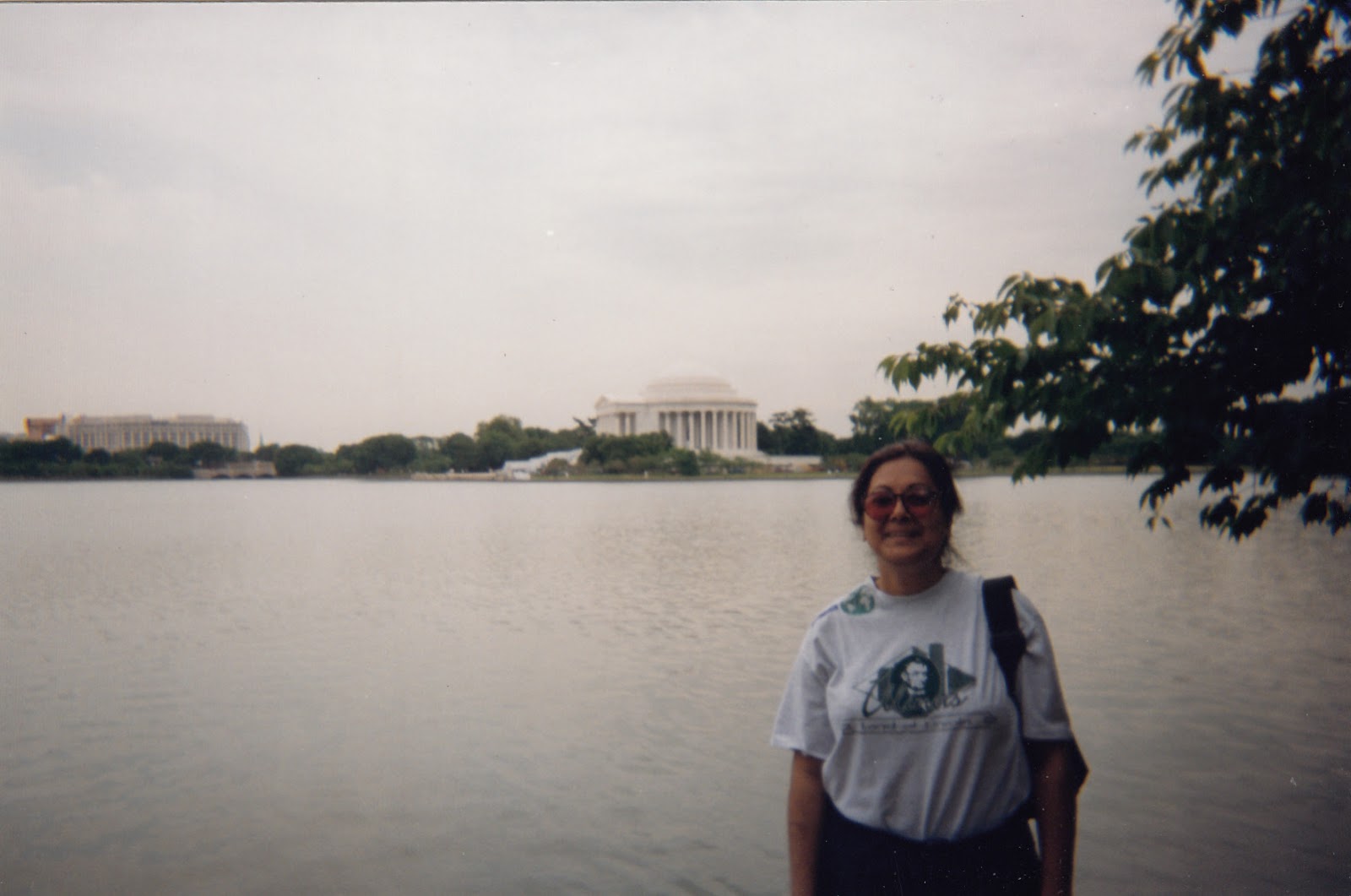
Jefferson Memorial across the Potomac Tidal Basin
It is a city of monuments and beautiful parks along its several avenues with very pleasant vistas. Our first site was the Lincoln Memorial, the monument for my favourite American President. “The government of the people by the people for the people shall not perish from the earth”, that is what Lincoln said during his famous Gettysburg address. He was a democrat and a libertarian to the core though he could not usher in liberty and equality for a very large number of his countrymen who even then survived as slaves in some states.
At Arlington Cemetery

The building is in the form of a Grecian structure which has inscribed on its walls the two great speeches by Lincoln including the one delivered at Gettysburg. This is one of the most visited National Monuments of the US and has been the site of many inspirational speeches including the “I Have a Dream” speech by Martin Luther King Jr. delivered just about a hundred years after Lincoln’s assassination. It was an elevating experience to tread the 
same piece of earth as these great Americans.
In front of the White House

Probably the tallest of obelisks, the Washington Monument dominates the Mall in Washington. It commemorates George Washington, the first president of the country who was claimed to be “first in war, first in peace and first in the hearts of his countrymen”. Standing at around 550 ft. it is virtually the symbol of the Capital. As we stood under the massive dome of the Capitol we could see the Washington Monument down the National Mall that ends up close to
The Capitol
Arlington Cemetery in the West in the state of Virginia. It is a fabulous sight. Made of marble the Monument was thrown open in 1880s and is a great place for lolling around on the well-maintained grass.

The beautiful Capitol building is where the American legislature comprising the two houses of American Congress congregates and makes laws and also ensures checks on the all-
At the Washington Monument
powerful US President. Here is where the Presidents are sworn in by the chief justice of the US Supreme Court. The building was completed around 1800 and was used for some decades as a church. The houses of the Congress used to meet then in Philadelphia. We were impressed by the dome and the columns that supported the two wings. The dome was reported to have been patterned on Les Invalides of Paris, only it is supposed to be double its size. Since we could not access the two wings we missed the murals and other decorations in them and on the inside of the massive dome. Branded as a Neo-Classical structure, it is highly impressive with its colonnaded frontage and a dome adapted from Paris.

A few steps away from the Capitol building is the Supreme Court of USA,
US Supreme Court
Again neo-classical structure which came up in the 1930s to provide for judges a dignified place of their own; otherwise they were earlier cramped up in the Capitol building where the needs of the Congress had outgrown the available space.

Arlington amphitheatre
We could see two of the several Smithsonian Museums – the National Air and Space Museum and the Holocaust Museum. The latter was most impactful as the Museum covers the whole range of activities of Nazi Germany  from beginning to end towards what they called “the final solution” – which in point of fact was extermination of Jews. Even the almost completely sealed box cars that were used to transport the Jews to the concentration camps have been put out as exhibits. It was a heart-rending experience. The Museum effectively uses the electronic medium to facilitate understanding of the exhibits.

Somehow or other we could not visit the Jefferson Memorial though we took a picture of it from across the Potomac Tidal Basin. Jefferson was
The Mall and Washington Monument behind usd
one of the founding fathers of the country, drafter of the American Declaration of Independence. We did, however, visit the Korean War Veterans’ Memorial. This was of recent origin as it was thrown open only in 1995. It has a long wall of highly polished granite with photographic images. More interesting are perhaps the bigger than life-size what looked like metal statues of the fighting forces in full combat gear disperse in the park. A very impressive memorial for those who fought the War!

Dome of the Capitol
We had to again cross into Virginia to visit the famous Arlington Cemetery across the Potomac. The Cemetery was initially owned by a Confederate General and only later passed into the hands of the Unionists. The war-dead of all the wars are supposed to have been buried here. And, of course, President John F Kennedy too was interred here where on the request of Mrs Jacqueline Kennedy, an eternal flame too burns. The whole place is steeped  in history and is a somber place.

We also went and saw the ‘regulation’ sites like the White House and the Kennedy Centre for Performing Arts.. A clutch of people were seen outside the White House which only indicated the attraction it holds for visitors being the seat of the most powerful man in the world.


Saturday, January 20, 2018

Scourge of malnutrition


http://www.bagchiblog.blogspot.com


“Save The Children”, an NGO is seeking donations for helping out the mal-nourished children in India. By ‘malnourished” it obviously means severely under-nourished children. It claims it has been saving children’s lives since 2008 and that last year it provided medical care and nutritional support to 1.46 lakh children.

 The extent of under-nourishment in India being what it is providing succor to only a lakh and a half children is actually no big deal. The problem is huge and perhaps it would need a thousand organizations like the Save the Children to liquidate under-nutrition from among the Indian children. It needs huge amount of resources, both of well-trained men and women and financial. Both being scarce, large-scale under-nutrition of children is not likely to be eliminated any time soon.

 It is, basically, a failure of the government despite its reach in the remotest recesses of the country where poverty is most manifest. Besides, the government has all the paraphernalia for the very purpose to extend relief to the stricken lot. An NGO can only do so much and not more. Any amount of donation is not going to be of help. It will not be like even a drop in the ocean.

According to a Rapid Survey of Children conducted by UNICEF about 30% of Indian children below 5 years in age are malnourished. What is more alarming is that 20% of them, which is more than a third of children of the world, suffer from wasting due to acute under-nutrition. This distressing situation does not quite match with technological boom in the country and its progressive economic growth.

One would tend to think that the government’s weak outreach has also affected the nutritional levels of children. These could be, inter alia, weak implementation of governmental nutritional schemes, inadequate health infrastructure, services, unsafe water, lack of sanitation and hygiene. All these, in addition to the reigning poverty in the country, particularly in its rural areas have contributed to severe under-nutrition of people across various age groups.

 Quite clearly a high economic growth rate does not take care of the entire population, especially those who are precluded from its benefits. It has been consistently held that the gross product based growth is veritably iniquitous. India has witnessed this phenomenon as since 1991 when the country opted for the capitalistic system after opening up of the economy rich have become richer and poor have become poorer if they have not stayed where they were.

While the economy registered high growth rate it did not in any way make a difference to the deprived lots of rural and semi-urban India. The aphorism “a rising tide lifts all boats” has not yet proved to be true for India. The country is almost always seen to be scraping the bottom as far as its social indicators are concerned.

And, yet the country is chasing GDP-based economic growth. A recent release indicating fall in the GDP growth rate was made an occasion by the Opposition to take pot shots at the government. Censure, condemnation, criticism, denigration, et al were hurled forgetting that under its own stewardship for fifty-odd years the country had achieved what is deprecatingly called the Hindu Rate of Growth of only 3.5%.

 But that is neither here nor there. What is important is that growth or no growth a large section of the country’s population has been wallowing in poverty for decades giving rise to all kinds of scourges, like hunger and diseases such as anemia, tuberculosis, malaria, HIV/AIDS and so on. But what hits them most is under-nutrition that is carried from one generation to another. Perhaps, it is time the fetish of GDP-based growth is given up in favour of growth based on improvement of general wellbeing of people, a better and healthier life for all.

 While tackling children’s malnutrition is important for the reason that on attaining adulthood they should, instead of being a drain, become productive members of the society, more important would seem to be tackling the under-nutrition of mothers. If women suffer from the results of under-nutrition, they would be incapable of providing the required nutrition to their new-born and other older children in the early years of their lives.

 Traditionally in the country’s patriarchal society nutrition of daughters is neglected from childhood. On attaining adolescence or maturity, with all the handicaps developed due to their under-nutrition, they are married off early and are made to slog in the kitchen. Patriarchy also deprives women the right to decide about spacing of children which is seldom observed, draining further the strength of an emaciated mother. Besides, patriarchy demands that women in the house get to eat only the leftovers which may not even be enough to satiate their hunger. So the chain of under-nutrition continues. This has got to be broken by providing succor to them by ushering in social change.

While hunger, child-marriage, depressed social status due to the prevailing caste system, unemployment and poverty are major reasons for under-nutrition, the situation is exacerbated by unsafe water and lack of proper sanitation and hygiene. Add to these the governments’ weak implementation of its policies and the prevailing unhealthy feeding and caring practices in addition to ignorance about healthy diets and what one gets is a lethal mix.

 It is in these areas that the government needs to mount an all-out assault, instead of chasing a higher figure of GDP. A healthy nation will be more productive than one that is stunted, wasted and under-nourished; in that event the gross domestic product will take care of itself. The World Bank estimates that India loses around 2 to 3% of the GDP on account of widespread under-nutrition. Laws like Food Security Act etc are useless, just as inefficiently implemented nutritional Missions of the Centre and various states. What is needed is concentrated sustained extension work in the affected areas to educate people about all matters relevant to under-nutrition.

Curiously, India has not used the leaves of the Moringa plant in the way Africans are using it to eliminate under-nutrition. Several researches have proved that the leaves of the plant have much more of the minerals and vitamins than what are found in conventional diet of vegetables and eggs. For instance, Moringa’s powdered leaves have 7 times more vitamin C than in oranges, 36 time more magnesium than in eggs, 50 times more vitamin B3 than peanuts and 50 times more Vitamin B2 than bananas. Even its seeds have been found to be capable of eliminating contaminants from water that cause so much of rural distress in India. It is a cheap way of dealing with under-nutrition. The plants grow with ease in almost every part of India and can be useful in greening the countryside. Since Africans are reported to be reaping benefits from this plant, sometimes called the miracle tree, there is no reason why India should not follow suit. The leaves of the plant are exported but curiously are not used to the desired extent in India.

Despite the Constitutional provision in Article 47 the state has not discharged its responsibility to raise the level of nutrition and improve public health. It is, therefore, for the government at the Centre and in the states to seriously take up the responsibility to deal with this huge problem instead of leaving it to ill-equipped NGOs who can only touch it only on the fringes.

15th January 2018

*Photo of moringa leaves and drumsticks is from internet


Monday, January 15, 2018

Memories of an ordinary Indian :: 10


http://www.bagchiblog.blogspot.com


Football in the Palace
That was not the only time I went across inside the Jai Vilas Palace. Sometimes when football matches would be played with Maharaja’s Jiwaji Club these would be held in the Palace ground. The ground was close to the gate on what was known as the Private Road. The players would take me along if I happened to be with father. Father remained as sports in-charge for a number of years and he had to accompany the team just in case the Maharaja decided to watch it. Those were the days of the feudal potentates. Their writ did run all over in their respective principalities though they were subservient to the British Crown.

Everyone, except the players and, of course, children, if any, would have to don their respective head gear as soon as they crossed into the Palace premises. According to the convention, none could get into the precincts of the Palace bare-headed. My father would put on his sola hat. Sola hats are not seen these days but they were very common before independence. One would see most of the officials wearing sola hats which, I think, were made in England and yet were priced very reasonably. The idea was surely to give fillip to the British industry.

 There would be very decent arrangements for witnessing the match by the Maharaja, his staff and the college authorities. Good looking chairs would be kept for them. Even the half time refreshments were decent. While officials would be served tea and biscuits the players would get the usual fare of lime and chilled water. Not any and everyone would be allowed anywhere close to the ground. I do not know whether there was some arrangement to prevent access of people to watch the match But obviously there was acheck point presumably the massive Palace gates.

 I would generally be made to sit on a chair in one of the back rows. Sitting so close to the football pitch would give me the strong smell of freshly cropped wet grass. I remember it so well that even now I can recall it, so well registered it is in my olfactory system.

 The college team would always beat the Maharaja’s Club. They were no match for the college boys some of whom used to be too good. I remember the two full backs – one was Kunzru and the other was Pawar. If anyone managed to take the ball past them the college would in all probability concede a goal. I used to like the way Pawar kicked the ball high up in the air and sent it far enough to cover almost three quarters of the ground. He looked a solid man, a no-nonsense type and would seldom allow the ball to get past him. The college had a very good goalkeeper, too, in a boy called Nandu. He was of above average height, lean and very agile and would make many remarkable saves.

Principals HM Bull and others

Talking of college football reminds me of the sight of the principal out on the field in the sun with his sola topee on his head looking for and removing teasel of Indian variety from the field. I was still a toddler and I remember his pale eyes as he would pick me up and try talking to me in, of all the languages, English. He was HM Bull who was so caring of his students that he would himself try to make the football ground teasel-free. He knew boys used to play barefoot and the spikes on the teasel could hurt them. There were no football boots those days and what most of the boys wore was only an anklet. It certainly did not protect them from injuries.

 HM Bull was followed by two other Englishmen as principals – MA English and FG Pearce – but neither ever bothered to go teasel-hunting. Surprisingly the Gwalior College (it wasn’t a post-graduate college till then) had English gentlemen as principals. The reason could either be the British regimes keenness to pursue Macaulay’s policy to the hilt or the Maharaja’s wish to ensure a better standard of education.  I might add that the Indian principals who followed viz. Dr. AR Wadia and DN Bhalla were no less qualified or competent. But it is true none of the ones who followed them ever went after the teasel on the college football ground.

Allies and football in Gwalior

In the early Nineteen Forties before the armistice football in Gwalior became interesting as the Allied Forces stationed in the town would play it with of a lot of passion and vigour. Among the forces were Australians, Canadians, New Zealanders and, of course, the British. I recall, the British were known as “Rovers” and the New Zealander called themselves “Wanderers”. They used to participate in the local tournaments and would often come to the College ground to play with the college team during the football season. They used to be quite formidable and even as a child I could see how puny and emaciated the college boys appeared in front of the hulk of these well-fed and well-cared-for big white men. Besides, all the white men would be playing with their boots on where as all the college boys, barring the two full backs, would be barefooted. On many an occasion one or the other college boy would collapse on the ground writhing in pain, perhaps, hit by a white man’s boot.

  It might be of interest to know that those days Football was a summer game in Gwalior and was almost never played in winters. Hockey and Cricket were winter games just as Tennis and Badminton were and were seldom played formally in tournaments in summers. I cannot imagine the reason as these days all the games are played round the year. Perhaps, the governments used to be short of resources.

*Photo from internet


Sunday, January 7, 2018

From My scrapbook :: 5


http://www.bagchiblog.blogspot.com


Size of leaves

Trees sleeping at night
I am back on the theme of trees. They somehow fascinate me and I can just not get enough of them.

Global warming has now become the driver of numerous researches about its effects on the planet’s flora and fauna. While some researchers have found significant relationship with global warming of shrinking skulls of moose that are residents of Michigan’s Isle Royale others are out investigating the effects changes in temperature have on the size of the leaves of various plants.

It has been said that plants have a delicate balance to strike when it comes to the size of their leaves. The leaves have to be large enough to absorb sunlight for photosynthesis but not so big as to use up a lot of water to cool them. New researches have shown that leaf size in most plants is actually determined by the difference between temperature of the leaf and the air temperature around it and the changes that occur between hot days and frosty nights. These results were obtained after analyzing more than seven thousand kinds of plants across the world.

Earlier the understanding in respect of the size of the leaves was more straightforward. It was held that those that were closer to Equator had larger leaves and as one moved towards the Poles the sizes of leaves progressively became smaller. Tropical rain
forests were full of plants with large and lush leaves while in arid areas and towards the Poles plants get by with tinier and tinier foliage. Researchers have, however, shown that in most plants limits to the size of the leaves are more set by the risk of freezing at night than by the risk of overheating during the day. The researchers also add that water has also a role to play. If there is enough water in the soil there would perhaps be no limit to the size of leaves.

 As climate change affects both temperature and water availability, understanding how and why plants will respond to such changes will be critical. The researchers have claimed “their model can help predict which plants, thanks to leaf size, will thrive in the new world” with progressively changing climatic patterns.

                                                              ***

Sleeping trees

That plants go off to sleep at night has all along been known. In our childhood we were told by mother never to tear off a leaf or pluck a flower at night as the plants go off to sleep as soon as darkness sets in. This advice was purely anecdotally sourced. Now researchers have proved that what we were told in our childhood is, in fact, true. Obviously, whatever was handed down to us had some kind of wisdom behind them.

Using laser scanners researchers from Austria, Finland and Hungary have attempted to measure “sleep movements” of fully grown trees. By monitoring a series of laser points on the trees they discovered that the trees more than 16 feet high dropped their branches by not around 4 inches at night. The experiment was carried out in two different countries, Finland and Austria in calm conditions with no winds.

 The scanners used infra red light for a fraction of a second on individual points on a tree. Infra red light is reflected by leaves and hence these were used to record their nocturnal movements. A terrestrial scanner was used to precisely map out a set of points on two silver birch trees – one in Austria and the other in Finland.  By making a series of these maps between dusk and dawn and measuring the displacement of each point they were able to trace how the trees moved during the course of the night. The leaves and branches of the trees were shown to droop gradually; the lowest they did so was until around a couple of hours before sunrise. However, with a few daylight hours they would be wide awake, as it were, assuming their daytime stance, as erect as they could be.

 It is being speculated that drooping may be caused by internal pressure in the plant cells which, it is felt, is because of photosynthesis. At night photosynthesis drops and hence production of sugars in the cells also drops, reducing the pressure. At the same time some researchers feel that by drooping their branches and the leaves on them the trees might be allowing their branches to ‘rest’ after using cell pressure during the day to angle their leaves to catch sunlight. Some others feel that the drooping of the branches and leaves could be a way to conserve energy.

Quite clearly, more researches are called for. Hopefully, these investigations will reveal the nocturnal secrets of trees which, presently, are unknown to most of us

*Photo from internet


Thursday, January 4, 2018

Bhopal Notes :: 59 :: Indian style development is enemy of greenery

http://www.bagchiblogblogspot.com


The local Smart City establishment seems to be seriously at work. Passing by, I happened to see that in south TT Nagar around half a century old low-rise residential government houses meant for the lower-level employees of the state government are being demolished. It is a very unpleasant sight.


One can quite imagine, with the demolitions numerous worlds have been destroyed and many of the inmates who spent a lifetime in these buildings were forcibly removed. They surely would have gone kicking screaming. After all, for years and perhaps decades these constituted their worlds. Here they married, had children, brought them up and launched them in the wide world to fend for themselves. They had developed their roots here that had gone deep during the long decades they spent here and uprooting them from their moorings would seem to be so cruel. But then, as Tennyson had said “Old order changeth, yielding place to new”, howsoever painful, a change has to come about replacing the old “order. And this change is mostly for that much bandied word “vikas” (development), which surely would not be of those who were removed from their hearths and homes.


It is a depressing sight. But in the depressing environment something stands out and captures your attention. Numerous trees – full grown and healthy – are standing next to the demolished homes. They seem to be there forlorn and in splendid isolation as they are bereft of their human company. These were not the trees that were planted by the civic bodies; these were planted, nurtured and cared for by the inmates who peopled the neighbouring now-demolished houses. Both of them had developed a symbiotic relationship of mutual benefit and mutual dependence. That relationship has suddenly snapped.


Perhaps, these have been left standing because of the backlash of the earlier effort of the administration to create a smart city at Shivaji Nagar after destroying hundreds and thousands of trees. That iconic image of Dr. Balwapuri of Red Cross Hospital in close embrace with fat trunk of a tree promptly comes to mind. The proposal to build the smart city there was given up mainly due to protests of the stakeholders of the entire neighbourhood. Only time will tell whether the trees of the South TT Nagar are going to be as lucky as those that escaped the axe in Shivaji Nagar. One has a hunch that they are going to meet the same fate as meted out to those which were felled to bring up Gammon India’s “Drishti” complex, charitably called “Central Business District”. Perhaps, the axes and bulldozers are waiting for the necessary clearance.


I say this because the city administrators are very ”axe-happy”. Despite the repeated reports of the city being rapidly divested of its greenery a big swathe of land along the Lower Lake has been cleared by felling a pretty dense assemblage of trees. This seems to have been done under the project of conversion of Minto Hall complex into a starred hotel and convention centre. The trees have been sacrificed for widening the road that runs along the Lower Lake and, perhaps, will provide access to the proposed convention centre. With two accesses for the Minto Hall complex already available the need for widening the road seems incomprehensible.


In any project the trees are the first casualties. Even the area next to the approach of the bungalow of the Mayor near Karbala quite a few trees have been felled for reasons that are still unknown. The place was green and cool with a good, dense undergrowth. But no, the axes wee wielded and the place looks so bare now. One wonders at the casualness of the officialdom and its penchant for taking such decisions that are harmful for the people.


Again, a proposal that was presumed to be dead is being revived. The proposal for construction of a guest house and few residences for MLAs was killed earlier about three years ago as it involved in felling of thousands of trees in or near the MLAs rest house complex. The protests put a stop to the project but before that a thousand trees had already been felled. The same proposal is being revived and the Speaker is reportedly pursuing the matter. On the last occasion some people had pointed out that there was hardly any need for new residences for MLAs as on bifurcation of the state a substantial number of them have now gone away to Chhattisgarh. But none is probably prepared to pay heed to any counter comment for the reason MLAs are the government and in the pre-election year the administration will also want to keep them happy.


Hence, with one project or another trees in the town are being sacrificed. None seems to think that trees are supportive of life and wellbeing, more so in these days of heavy air pollution and scarcity of water. Surprisingly the civic bodies that are entrusted with the duty of creating clean and healthy spaces for people are the worst defaulters. They seem to have sworn to divest the city of all its greenery leaving the citizens to contend with the rise in air pollution that fosters diseases and death as also unconscionable rise in temperature making the once-salubrious city unlivable.


They apparently are ignorant of the various researches that have shown how valuable a city’s greenery is. A new research, results of which have been published in the journal Ecological Modelling, indicates how much money trees can save for a city. After studying 10 megacities around the world and taking into account air pollution, storm water, building energy, and carbon emissions, the researchers found that trees have an economic benefit of about $505 million every year. Researchers from State University of New York College of Environmental Science & Forestry and Parthenope University of Naples found that trees are worth $1.2 million per square kilometer or $35 per capita.


But in India none probably cares – more so in the states and their municipalities. In the case of Bhopal, the local civic body and also the local government have been unmindful of the impacts of their actions to add more cement and concrete structures in the city. They have scarcely reacted on the repeated reports of tumbling greenery of the city. Besides, they have been singularly unsuccessful in taking care of what was received by them as inheritance in the shape of natural and man-made assets from their feudal predecessors. In fact, they have tried to destroy most of it, chasing a mirage, as it were, of development and progress.


*photo from internet

Tuesday, January 2, 2018

Memories of an ordinary Indian :: 9


http:// www.bagchiblog.blogspot.com

Jai Vilas Palace (Photo from internet)
The Palace was something which we would notice immediately on getting on to the terrace. Its four white towers used to be illuminated. On top of one of them there would be red light on at night. This was the indication to the townsfolk that the Maharaja was in town. When he would be out of town the red light would be switched off. Sometime later Maharani added two bright lights at a level lower than the red one – perhaps on top of the Usha Kiran Palace where the “royal” family used to reside. People would know that she was in town when they would be on

Jai Vilas used to be a very closely guarded Palace. None could walk into it. However, long years ago when I was very small I remember walking right through it one evening with my mother and one of her acquaintances who perhaps was Mrs RK Hukku, the Head Mistress of the neighbouring Miss Hill’s School.  The city was in festive mood with buntings all along the roads. Perhaps, the occasion was the wedding of the Maharaja. Entering through the Private Road gate we walked alongside the Palace with gardens on two sides and then exited through the gate (known as Nadi Darwaza) that was almost beneath the parapets of the Fort. The entire Palace complex was illuminated and decorated like a fairyland. As we stood around to perhaps catch our breath and to give some rest to our tired feet the parapets exploded in fiery colours. The evening fireworks had commenced and the Fort was probably chosen as the venue only to enable the entire town to witness the celebrations. It was indeed an unforgettable scene.

To my infant eyes the Palace looked beautiful with its four tall square-ish towers and the entire double-storied structure painted white and bathed in bright luminous light. Several recessed windows
The recessed windows of Jai Vilas Palace
had very little ostentation. It was a huge complex which, in fact, was not being used as the royal residence. (I happened to see it from inside years later after it had been converted into a museum). The royal family had a smaller palace adjacent to it but Jai Vilas Palace was where all the state functions used to take place. It was built in 1874 for the current Maharaja’s great, great grandfather, Jayaji Rao Scindia, the then ruler, with Sir Michael Filose as the architect. Reputedly, built on the likeness of Versailles Palace. When, years later I did have an occasion to see the palace at Versailles. I just couldn’t connect it with Jai Vilas However, at least as far as I am concerned, I found it better looking than the Buckingham Palace. When I happened to stand before the Buckingham Palace much, much later I was deeply disappointed with its looks. It looks squat, bland and grim like some of its residents while Jai Vilas has a more interesting facade and has some architectural character.

                                                                           ***

The Victoria College clock tower was another striking feature that stood out and captured the attention from the terrace. The College was where my father used to go every morning to teach. It was around 50 years old then, inaugurated by Lord Curzon in 1891. It was a degree college and the only one in Gwalior State. We used to go to the College grounds every day along with father who would be playing tennis or badminton or even occasionally acting as a referee in football matches. We used to be mostly the only kids of a professor around and hence would attract the attention of the students almost all of whom were well-known to my father. Invariably every time a group photograph of the College team of football or hockey would be taken the boys would take us along if we happened to be around to sit on the ground along with some of them. The two of us – the two youngest siblings – figured in many such photographs, the earliest one I remember was of 1939 standing close to my father in my green blazer with even a tie.
Victoria College

 Those days the strength of the colleges used to be small - in hundreds, not like the present times when the strength touches five figures. When I used to be a toddler the College probably had only 150 students. Gwalior was a small town and only the middle class – then very small in size – would be able to provide higher education to the children. Unlike the present times, the teachers were a highly respected lot – not only by the students, but also by the feudal and far richer businessmen. Knowledge was respected and those who possessed them were highly regarded.

While talking of college group photographs I am reminded particularly of one student whose name
was Naeem Ahmed. It was he who would insist on our being included in the photograph. He would keep telling us to look at the camera lens as a bird was to fly out of it – an old ploy to prevent children from being distracted. He was short but a handsome boy with wavy hair who used to be a very good badminton player. Partnering with one Hafiz Ahmed he regularly won the doubles trophy. He would frequently come to our hose to take lessons from father. While he would wait we would go and give him a few tickles. He enjoyed them as he was a good sport. Before leaving for Pakistan he came and saw father and all of us. We were sorry to see him go as indeed we were sorry to see Abdullah leave. There was so much of goodwill between us and it was suddenly snapped.

The clock tower of the College would register its presence right through the 24 hours of the day with its hourly melodic chimes that were, for want of any noise of motorised traffic, audible for quite some distance all around. We could hear the chimes in our house, more so at night. Talking of the clock tower reminds me of the evening when two of my siblings and I in the lap of a help had gone up the three floors of the clock tower. The weekly winding up of the clock was due that evening. The narrow confines of the tower unnerved me and then all of a sudden ear-splitting, deafening chimes – six for the hour of six – frightened me to tears. Inside the tower the chimes were horribly loud, more like blows of a hammer and did not sound to me melodic at all.


*Photos from internet


DISAPPEARING FREEDOM OF EXPRESSION

http://www.bagchiblog.blogspot.com Rama Chandra Guha, free-thinker, author and historian Ram Chandra Guha, a free-thinker, author and...