Tuesday, July 31, 2018

Memories of an ordinary Indian :: 17 :: On to School


http://www.bagchiblog.blogspot.com


My parents thought it was time for me to go to school. I was now around six and curiously they thought it was getting late. I say curiously because others in the family did get education at home till they were eight or nine. Perhaps my mother, with all her domestic chores, was not able to find time to take care of my learning. So one morning one of my father’s students took me not to the Gorkhi Middle School where my other brothers were admitted but to Sarafa Middle School. It was a government school, a private schoo,l like an American’s Miss Hill’s School, was not chosen presumably because of its higher fees. He took me straight to the Head Master who appeared to me rather impressive. He was, surprisingly I noticed, well shod and was in a tie as also wore a learned look with thick horn-rimmed spectacles. He promptly asked me to recite the table of 13. By the time I reached 13x8 he asked his orderly to get the Section 3B teacher. The teacher was asked to take me to the class and register me as a new pupil.

I accompanied the teacher to the class which was not a room but only one end of the outer verandah of the building. The street in front was screened off by removable curtains of cane and cotton cloth stitched on to them. Two stretches of jute cloth were spread on two sides on the floor with the teacher's chair and table at the end. The students were to sit on the floor. We all sat on the floor, i.e. on the jute cloth. The other end of the verandah was occupied by Class 3 Section A.

 It was a boys’ school. We had only one teacher, a dhoti-clad Maharashtrian with shaven head with a long tuft at the back. He used to teach us Hindi, English, Arithmetic, local history and geography – practically all the subjects. School hours were from 7.00 to 11.00 in summers and from 11.00 to 4.00 in the evening in winters. We were taught by the same teacher right through the school hours. He too seemed to have had, from hind sight, tremendous staying power to deal with 30 or 40 odd children and the din that they raised for four or five hours without losing his head.

One peculiar thing I recall, in view of the current yearly change of text books is that we had no such problem. Year after year the courses would remain the same as did the books saving that big hole in the budgets like those of the parents these days. We used to inherit the books from our elder siblings. No wonder my mother always used to ensure that the books were kept in good condition. I remember I used the same English language book, Himalayan Reader, that was used by my eldest brother six or seven years earlier; then it rolled down from brother to brother, at the end it came rolling down to me. This was true of books of all the subjects in all classes up to matriculation.

We had to have a slate and a pencil as also  single line and four-line note books. The four-line note books were meant to inculcate in us the habit of writing each letter of the alphabet properly. We had to have a special nib, the G nib, for writing in these note books. If one wrote well on these notebooks with the G nib the writing would   appear somewhat like Old English. There were no ball-point pens those days; it was pen and ink that one had to have in a pot. Fountain pens were a strict no no.  Among the writing instruments was also included a pen of cane for writing Hindi in white on a small wooden plank painted black. This apparently was like the use of G nib for lending to the written script a classical appearance.

The class teacher was a hard task master. If the tasks given on previous day were not carried out he would cruelly punish the boys. Those days the belief was “spare the rod and spoil the child” and I remember a child got a bad hiding for not doing the home work. He kept crying right through the remaining school hours.

It was a kind of socialism in the class as even our maid’s son was with me. The tuition fee was abysmally low and looks ridiculously low from today’s standards; it was only three paise – three quarters of an anna which used to be sixteenth part of a rupee. Of course, things were very cheap as the prices I remember appear preposterously low. A 32-page single line note book of widely popular Elephant brand with good quality paper would cost two and a half annas and a pencil that we used to use just an anna or maybe an anna and a half. An anna would fetch a samosa and a colourful ice candy we would buy in half that amount. This was seventy five years ago. But I still feel the Maharaja was also subsidizing education of boys – girls’ education was free right up to the college level.

Since there was no playing ground for the school we used to run across the street in front to a pretty big rather badly maintained park during the recess. The only traffic we used to come across on the street was of cyclists and horse-drawn carriages called tongas. There were hardly any cars or motor bikes. We used to play the game of seven stones in a rather big clearing. On many occasions the ball would miss the target and would travel across to the other side of the park where there was another street known as Phalke Bazar. Phalke was a minister in the Gwalior State and was an autocrat and a feudal contributing to the Maharaja from his revenues out of his huge land holdings. His two sons became my friends at the college and another elder one was a very good friend of my big brother.

Health of the boys seems to have been of great concern to the administration. Every year small pox vaccination was a ritual. Small pox was rampant in those days. Besides, vaccines against cholera and typhoid were routinely administered. These diseases would suddenly spread and take lives of large number of children. I remember after the first TABC injection I cried so much that in desperation the teacher asked me to get back home. I ran a fever for couple of days with pain in the arm that got the shot.

Likewise, the quality of education was monitored by annual inspections. There used to be a flutter in the school whenever the inspector of school came. He would come on a bicycle accompanied by a liveried official who would promptly take care of the bicycle as the inspector alighted. I happened to see the process once from my place in the class. He also came to our class once accompanied by the headmaster, asked a few questions and was apparently satisfied and walked away.

Four years passed uneventfully and as I cleared the Class VI examination my father thought I should get to a better school. Our private tutor suggested the local DAV School, run by Arya Samaj, a Hindu Reform Movement, and thither I went in the next session.

Saturday, July 28, 2018

Destinations :: North-East ::Kazi Ranga (1990)


http://www.bagchiblog.blogspot.com

A quintessentially sight of an Assamese tea garden

One morning we drove out of Shillong for Kazi Ranga. Kazi Ranga is in Assam and has extensive grasslands which host the famous Indian one-horn Rhino. It also hosts wild elephants, tigers, wild buffalos and assorted wildlife including a variety of antelopes.

We had to go through Guwahati and so we headed for the Assamese capital. It seemed to have quietened down from its recent turbulence. But tell-tale signs of its unobtrusive simmering were still around. The fabulous Manas National Park was closed as the ethnic militants were in occupation and businessmen in the State had to part with substantial amounts towards the security of their person as also their property. 

From Guwahati we took the scenic highway on the north bank of Brahmaputra. An important town located on the north bank is Tezpur - a town that was under serious threat during the Sino-Indian War of 1962. Now it has a biggish Indian Air Force base. It has a beautifully located circuit house, the new wing of which is right on the river bank. The windows offer magnificent views of the Brahmaputra. It was a delight to spend some time there.

 There are numerous legends for the name that the Kazi Ranga Park was given, the most
The expansive Brahmaputra
popular being the one about two lovers from two different tribes who, when not allowed to marry, fled into these forests never to be seen again. The girl's name was Rawanga and the boy's Kazi and the forests came to be known as Kazi Ranga. The Park has a long history as will be evident from the fact that it celebrated its Centenary in 2006. It was Lady Curzon, wife of the Governor General Lord Curzon who being unable to sight a single rhino during her trip across the jungles recommended to her husband steps for conservation of the animal. As a consequence Kazi Ranga Game Park was established in 1906. As the name Game Park suggested that hunting was still permissible it was changed to Kazi Ranga Wildlife Park in 1926. It was, after all, hunting that had eliminated all the rhinos that deprived Lady Curzon the view of even a single rhino. Late in the Twentieth Century its name was changed again to Kazi Ranga National Park and Tiger Reserve. The UNESCO awarded it the status of World Heritage Site in 1985.

Kazi Ranga has a variety of wildlife. Apart from its rhinos which constitute two thirds of the population in the world of the animal, it also has the other pachyderm, the Asiatic Elephant, in
In pursuit of rhinos
substantial numbers. The latter’s current number is more than a thousand. The rhino population, however, has shown a remarkable upswing. From around hundred odd in the initial years of the last century the count has now come to more than two thousand. The Park is also the largest tiger reserve in the country hosting more than a hundred tigers apart from being a refuge of the Indian Wild Water Buffalo. Along with assorted antelopes and other smaller animals it has a large variety of birds some of which like hornbills are rare in other parts. The Birdlife International has designated the park as an Important Bird Area for its varied species of resident and migratory water birds.

We mounted an elephant at the Elephant Station and took off for the forests.. Soon I realised that we were moving through the grass that were as high as the elephant or even more. As the elephant moved the grass that was rather stiff brushed against our legs.. This was, I realised, elephant grass country which I had never been to before. The elephant was walking through it
The coveted sight
sure-footedly. I wondered how it managed to negotiate the invisible highs and lows of the ground with such facile ease.

Soon enough the elephant came to a halt. The mahout whispered there was a tiger around. The pachyderm advanced with great care, as stealthily as possible. But nothing perhaps can escape the sharp olfactory sense of a tiger. It deserted its kill that was right in front of us in a small clearing. It was a half-eaten water buffalo of such massive proportions that amazed us. It was a huge hefty beast with its muscles shining through its beautiful black coat. It had lovely swept back and curved horns that seemed to have had a polish recently. Its hind quarters were eaten
up with dark red blood flowing freely from the large-sized wound. We did not tarry further and moved away from the spot to allow the tiger to resume its meal. I ruminated over the kill and
Sunset on Brahmaputra at Tezpur
reckoned only a ravenously hungry tiger could bring down such a massive creature. But how big was the tiger? The answer eluded us as we could not sight it.

We were unable to see any tiger. In such tall grass it is impossible to see one unless it comes out into a clearing. We were also deprived of the sight of a live water buffalo. Perhaps it would have been well worth the effort to try and see one. Our target was rhino so we moved in pursuit of them. We didn't have to go far looking for them. They were there in good numbers. After having seen the African two horned rhino I found our own ones rather likable. With its single horn it looks less belligerent though with the armour-like folds on its body it gives an entirely different impression. It is generally shot for its horn that is valued in thousands of dollars. It loses heavily in numbers for this reason. Massive efforts
Barak Valley below Jaintia Hills
for its conservation have shown a rise in their numbers.

Looking back, I feel the most impressive sight in Kazi Ranga was of the dead buffalo, its build, its muscles and its massive horns. One wonders how it failed to gore the tiger with them. Then, of course the flight of a hornbill was something that was worth watching.. The elephant grass, too, were very impressive. I don't know whether the grass in Mudumalai is similar to these.

On our way back we stopped at a wayside kiosk where green coconuts were being sold. The coconuts were so peppy that when the seller punctured the shell its water gushed out in a jet and went up as high as around couple of metres. I had never seen such peppy tender coconut, not in the South, nor in Sri Lanka or even in South East Asia.
.


Friday, July 13, 2018

Trees are not dispensable


http://www.bagchiblog.blogspot.com


'
When things reach an edge Delhi’s civil society comes together to rally and protest for public causes. In 2011 the rampant corruption in the Manmohan Singh government threw up a Gandhian Anna Hazare who was agitating in Maharashtra for years against local corruption and then came to Delhi with support of various civil society leaders. He evoked tremendous response in his protracted agitation, including a prolonged fast, supported by unorganized members of public, forced the government to assure that his main demand of creation of a Lok Pal would soon be met by suitable legislative action. That, however, turned out to be ruse as a Lok Pal is yet to be appointed. The movement, however, gave birth to Aam Aadmi Party which has been ruling in Delhi with a rather scratchy performance for around four years.
Again in December 2012 when “Nirbhaya”, a young girl, a physiotherapy intern, was brutally raped and physically abused by the staff of a commuter bus which eventually led to her untimely death the civil society of Delhi again rallied round for greater safety of women on Delhi streets. It forced the government to enact a series of stringent anti-rape laws. The laws may not have reduced the incidence of rapes but the civil society’s rallies and demands in unison sensitized the administrations of the entire country against such horrendous crimes against women. On account of that unrelenting movement the accused in the Nirbhaya case have since been awarded death penalty.

Now once more, as the wellbeing of people of Delhi has been threatened by the proposal to cut down as many as 14000 trees for the so-called re-development of quite a few South Delhi residential colonies, including Sarojini Nagar, Netaji Nagar and Nauroji Nagar, they came out in strength to strongly protest against the decision of the government. The protests were so strong, especially because of the rising pollution and temperature in Delhi that the government had to back off. The court and the National Green Tribunal, where the matter had been taken, imposed a stay on further cutting down of trees. The Minister for Housing and Urban Affairs ordered that no tree would be cut and asked for redesign of re-development plans of the long-established colonies. Such is the power of the civil society when it chooses to rise in protest. One wonders what kind of planners have been engaged who seem to have been oblivious of the current extremely high level of pollution in the city and have suggested felling of as many as 14000 trees existing in these colonies for decades. This after the Delhi Forest Department indiscriminately allowed massive tree-felling in Delhi.

Something obviously is wrong with the Forest Department of Delhi Administration. Reports indicate that in the last seven years it has given permission to fell more than 44000 trees and now it had again permitted felling of as many as 14000 trees for the so-called redevelopment of South Delhi colonies. The officers of the Department seem to have lost all sense of proportion. Whenever proposals are sent to it for felling of large number of trees they impose only token cuts allowing large-scale felling. They have displayed utter apathy towards the health and wellbeing of the citizens of Delhi and their environment. One imagines their mechanical way of functioning, unless checked, will convert Delhi into a desert in not too distant future. Besides, the City is already highly polluted with PM-10 and PM 2.5 levels way beyond normal. Such massive tree-felling operations will greatly enhance atmospheric pollution. The City’s citizens are already choking and with so many trees gone they would be exposed to untold health hazards.

It seems, none ever pays attention to the welfare of the citizens – neither the government environmental conservation agencies nor the bureaucrats or city planners. They are only interested in building concrete jungles replacing all greenery. Their argument that compensatory plantation will be carried out has proven to be only a ruse. Besides, saplings cannot be substituted for full grown decades-old tall trees with widely spread–out canopies. It is only the canopies which intercept the particulates and also provide shade to the commuters walking on the hot asphalt in summers.

In accordance with rules, for every tree cut down ten need to be planted. Often so much of land is not available in and around the site of the cut-down tree. The compensatory plantation is thus carried out wherever land is available which is generally in the outskirts of the city. This does not help in any way the localities where mass-scale tree-felling is undertaken. Besides, authorities often do not plant native trees; they go in for decorative or ornamental trees which are of little help in conserving the environment. Compensatory plantation is actually perpetration of a fraud on the people. A rate of survival of 30% of planted trees is considered good but generally only 10% survive. Pradip Krishen, author of Trees of Delhi, a strenuous study conducted by him, says “the concept of compensatory plantation is fundamentally flawed. The land has poor quality soil – the reason why it is vacant in the first place. And the agencies are interested only in meeting targets.” The forest departments’ business is to protect forests and trees. They do not pursue compensatory plantation with due diligence and yet they indulge in large-scale felling of trees.

Translocation of trees, a practice that is being bandied about, is also not very successful. The success ratio has been poor in trans-locating fully grown trees with their entire ecosystems of parasites, insects and animals mainly because of lack of adaptability in many accompanying organisms and unfamiliar as well as strange, sometimes even hostile, ecosystems of the new surroundings. Besides, removal of a fully grown tree from its moorings inflicts a severe shock on it which alone sometimes is cause of its end.
Though already a few thousand trees have been felled in some of the ear-marked colonies yet Delhi’s environment has been saved for the time being. Now that the Minister concerned himself has taken matters in his own hands the redevelopment projects are likely to get drastically modified. Credit has to be given to the civil society of the city which did not take the decisions of the authorities lying down. They rose up in protest and forced the authorities to re-examine their decision.

Numerous other cities are not as lucky as their civil societies seldom rise against local decisions that hurt their interests. But in places like Bhopal severe protests by civil society forced the government to trash the builder-oriented City Development Plan 2005. Likewise, in 2015 widespread protests forced the government to change the site of the smart city as thousands o trees were to be felled destroying green ambiance of the city. Nonetheless, urban areas need to draw a lesson from Delhi and ensure that their health and wellbeing is given priority over the dreaded word “vikas” and hence whenever there is a confrontation between the two they have to stand for their own interests. There can be no trade-off between development and environment.

*Photo from internet of cluster of tree in highly urbanised Chicago


Tuesday, July 3, 2018

Destinations :: North-East :: Tura (1989)


http://www.bagchiblog.blogspot.com


Under a Garo Hills tree house
I had heard of ­­Garo Hills (Garo Pahaar in Bengali) from my father. He used to talk of tigers swimming into their property whenever there would be heavy rains on the Garo Hills. Waters from the Hills would cascade down creating floods all around. The tigers, of course, would be would be chased out by my grandfather and his brothers wielding nothing except lathis (bamboo sticks). Their property was in the town of Sushong in Mymansing district of East Bengal (that is now Bangladesh)­­­ at the foot of Garo Hills.

When I was posted in the North East I had an intense desire to visit Garo Hills. The
A river in Garo Hills
region was divided into two districts of East Garo Hills and West Garo Hills It was for the district headquarters Tura of West Garo Hills that we had to head when we decided to visit these not-so-well-publicised hills. East Khasi Hills with its district headquarters Shillong is much more well-known and has that exotic value – scenic and touristy. Garo Hills are not quite known outside the state and the only big town Tura, actually the second biggest town after Shillong in Meghalaya, is also obscure for many.

We had to climb down from Shillong and come to Guwahati, Capital of Assam and
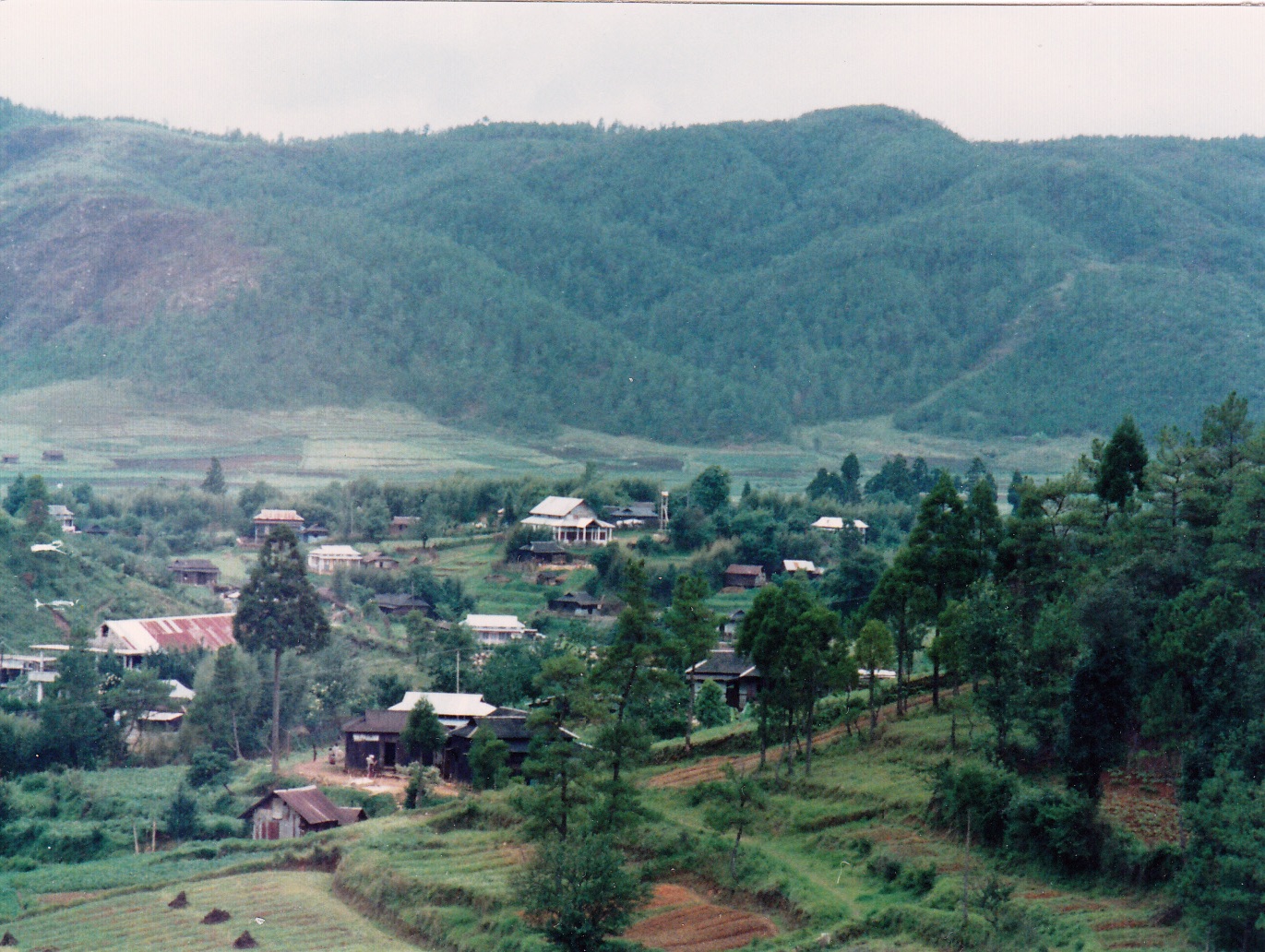
Tura Peak (from internet)
then take the road on the north bank of River Brahmaputra to travel westwards. The drive of about 200-odd kilometres was captivating. It was lovely country all through. After all, it is Brahmaputra Valley that keeps the surrounding fields green. As we approached Garo hills we saw huge jack fruit trees laden with massive fruits hanging out of even the fat trunk at a man’s waist height. This was something I had never seen earlier.

Climbing the Hills of around the same height as Khasi Hills we saw Garos busy in their
Garo Martyrs' Memotial
fields. One peculiar thing we saw was the tree house. Many Garos have created houses on trees or erected them with the help of bamboos with a covered room at

the top. The covering in most cases was just thatched; a bamboo ladder led one to the top. This was used to guard the crops against wild animals. In some parts of Garo Hills wild elephants still roam free. Garo Hills has an Elephant Reserve yet many elephants move around outside the protected area. Mostly forested, the Garo Hills have few reserves, one is near Baghmara in South
A proud Garo, owner of a tree house
Garo Hills.

 Tura is a hilly town – of hills and valleys dominated by Tura Peak. It has a moderate climate and sparse population which is largely Christian. English is pretty commonly spoken though Garo native languge and Hajong are largely used. There are a number of supposedly good Christian secondary schools and a few colleges. The place is where the Arch Diocese of Roman Catholic Church resides. The town is picturesque with hills, valleys and rivers flowing by.

In Tura we came across a fig tree that had numerous low hanging fruits. But we were told that these were inedible as they harbour insects, bees and flies. Indeed,
This one is supported by trees
when one was cut open a bee-like biggish and dangerous-looking fly came out and flew away.

A visit to Baghmara was slated for me. It is situated almost at the edge of Garo Hills in the south at the international border with Bangladesh. Baghmara is the place where Capt. Williamson A Sangma, the founder chief minister of the state of Meghalaya was born. From here I was told my father’s place Sushong was only 20 kilometers away but it would be much less for a crow if it flew from here across to Sushong. I could see a small settlement. It was a clear day and visibility was good and yet because of the vegetation very little was visible. Bangladesh is a wet place and trees would seem to be everywhere barring the farm lands. It was like the same sight we had of Bangladesh from the heights of Cherrapunji. It is a small place and thinly populated.

 The small establishment of the office was pleased to receive a head of a circle who

Another Garo river threading its way do
seldom visits such small places. The office was in a pucca building with a quite a bit of land all round with numerous tall trees. On one such tree we espied a blooming flower at its top. Soon enough the guard got a long enough bamboo stick and brought down part of the flower. It was far too big for just a part of the flower and it was none other than an orchid with varying shades of pink on its petals – a beautiful creation of Nature. The whole flower must have been a massive one growing undisturbed. The staff was told to allow it to remain on the tree.

Soon it was time for us to leave. Our driver, a Mizo by the name of Lushai, suggested that we take the state road through the hills. I thought the idea was welcome and we headed for the district head quarters of East Garo Hills. A few kilomtres away

A Garo kite
from Tura is Sisbibra by the side of a river where a memorial has been created for the martyrs including Togan Sangma who resisted with their traditional arms the British incursions and fell to their bullets.

 The district head quarters of East Garo Hills has been named Williamnagar after Capt. Williamson Sangma. We halted at Williamnagar only for a little while and proceeded towards Nongstoin, headquarters of East Khasi Hills. We did not stay there too for long as our driver espied some bad elements
Greens of East Khasi Hills (from internet)
eying our vehicle and following it. He wanted us to leave quickly for Shillong and we thought it wise to go by his advice. All I remember of Nongstoin and its surroundings beautiful green cover all around – like a massive golf course. I understand there are many natural features in the district that are worth seeing. Nongstoin has now been connected with Shillong and Tura by a beautiful highway that seems to be world class and is picturesque.


Friday, June 22, 2018

Destinations :: North-East - Shillong (1988-90)


http://www.bagchiblog.blogspot.com


Umium Lake
It was late evening, dusky with menacing clouds. We were on our way up from Guwahati to Shillong. Rain came down in torrents just about when we were labouring up a steep hill in an ancient Ambassador. Through the thick shroud of falling rain the forest on both sides looked menacing. Suddenly, the car stalled and came to a halt. The driver, a Mizo, unlocking the bonnet, got out unperturbed in the blinding rain to investigate. A little tinkering and the dead engine miraculously came to life. Thanking God for saving us from a soggy night out in the wilderness, we moved on, reaching Shillong around nine – somewhat late by north-eastern standards. After a four-year stint in Maharashtra, we were heading to Shillong on a posting for two years to preside over the North Eastern postal administration. 
                                                               
A misty view from our living room window
Waking up next morning to a glorious sunshine we forgot the mishap of the previous evening. The green, thick-with-pines hills of Oakland, the neighbourhood we were parked in, were bathed in gorgeous sunshine and, set off against the turquoise of the sky, looked devastating. A bracing gentle breeze blew across the trough immediately below that once was the polo ground. Beyond we espied range after range of Khasi Hills in bright sunshine. Bowled over in the first few minutes that we spent out in the open, we realised what everyone said
In our front yard
was really true. Shillong was, indeed, incredibly beautiful.

No wonder, with all its undulations, it has been given the sobriquet of “Scotland of the East”. The striking resemblance with the Scottish Highlands is further reinforced by the ubiquitous tartan that the Khasi men and women wrap themselves with. Its Tudor houses, the gardens, the works, remind cognoscenti of Devonshire or Sussex. Incidentally, we were allotted a house that was essentially Tudor in  design and very comfortable w2ith added attraction of whispering pines within touching distance. Tucked away in the remote north-eastern hills, untouched by hordes of tourists, it has also been branded as the country’s “secluded Shangri-la”.

Drawing its name from the Khasi God “Leyshyllong”, who is believed to be residing on the Shillong Peak, Shillong was a small village until 1864 when it became the civil station for Khasi and Jaintia Hills. The British also used it for rest and recuperation. It remained the summer capital of eastern Bengal and Assam for many years. On the
A smll part of Shillong
formation of the Assam Chief Commissioner’s Province in 1874, it was the obvious choice for being designated as the capital. It remained so until 1972 when on formation of Meghalaya comprising the Khasi, Jayantia and Garo Hills it became the capital of the new state.

Perched on Khasi Hills at an elevation of about 5000 ft. above sea-level, Shillong is blessed with substantial rainfall and an equable climate, though winters could be cold. Perennially dressed in green, it offers crisp, clean air and a nature that is feast for the eyes. The town’s
Forest along Camel's Back Road
attractions, therefore, are in its natural features, peaks, falls, lakes and gardens. Laitkor Peak, commonly known as the Shillong Peak, at about 6000 ft. is the most important and is the highest point of the town, as also of the state. An air force station located on it keeps vigil with its radar over 400 kilometres all around. Nearby are the two falls, Gunners’ and the Elephant Falls, both beautiful places for a day’s outing, more so during the monsoons. Just beyond are two other falls known as Upper and Lower Elysium offering just as pleasant views
Other attractions are the two lakes. The one plumb in the town is the Ward Lake, a
Our living room
serene body of water surrounded by green hills. Beautifully maintained, with a botanical garden thrown in, it was always a pleasure to spend some time in the midst of nature. We would walk over to it, stroll around on its winding paved pathways lined with flower-beds, stand on its picturesque bridge feeding fish and then retire to the cafeteria for a refreshing cup of coffee.

The other one is much bigger, the Umiam Lake, commonly known as Barra Paani. Only 17 kilometres away from the town it is a picture-postcard country with the blues of the skies reflected by the water of the expansive Lake fringed by green hills.
Another view of the living room
Offering facilities of various kinds for water-sports at the Lake, the Meghalaya Tourism runs a Charles Correa-designed Orchid Lake Resort with well-appointed rooms. We, however, just sat around out in the open, taking in what nature so generously offered.

Known for its orchids, Meghalaya claims to host 600 of the 800 species that are found in the country. I found a few blooming on wayside trees which I promptly captured on film. The Orchidarium run by the
A fall on way to Cherrapunji
Botanical Survey of India offers a large collection of them under one roof. We were lucky to see several varieties in bloom. We also saw for the first time in our life the pitchers with blood-red lips of the carnivorous pitcher-plants that the Botanical Survey grows in its extensive gardens. Some of the pitchers were of impressive proportions.
With so much of greenery around, the place had to have a generous population of butterflies. For the visitors the Museum of Butterflies is a must-see, something which we never saw anywhere in the country.

Shopping is mostly in what is known as “Police Bazaar” or the more sophisticated Laitumukhrah. Burra Bazaar, “Iewduh” as the locals call it, however, is an interesting tiered shopping complex on a hill-slope. From shoes, cloth and sundry other items to everything edible is available in this huge complex that is somewhat like an ethnic mall. Pineapples, my favourite fruit, were dirt cheap. Dolled up Khasi women, wearing traditional aprons with colourful chequered shawls can be seen selling fish
Wards Lake
or betel-nuts, locally known as khowai. While porters carry loaded baskets suspended from their foreheads, people shop, haggle or simply chat in the midst of this relentlessly on-the-move humanity. Although not for the squeamish, its USP is its uniqueness.

For diversion there is the 18-hole Shillong Golf Course, once reportedly listed among the world’s most beautiful one hundred golf courses by the Readers’ Digest. Close to the town, its picturesque fairways and greens attract even non-golfers. Diversion for the more ordinary, however, are the archery contests held every afternoon in the Polo Ground. Betting and imbibing fiery local
A Pitcher plant
brews go hand in hand evoking varying emotions – heights of euphoria and depths of depression.


Though Cherrapunji has yielded its place to Mausinram as the wettest place on earth, its earlier reputation drew us to it. With about 800 inches of rain per annum, we had imagined a dense tropical forest of sorts. At the end of the 55 kilometre trip we were amazed to see a bald plateau, bereft of all vegetation. All that rain simply runs over the rocky surface and down the precipices into Bangladesh. The trip was,
Forseted road sides
nevertheless, made memorable by a few remarkable way-side water-falls and the view from Cherrapunji of the plains of Bangladesh a few thousand feet below.

A melting pot of several ethnic groups – north-eastern tribes, Nepalese, Bengalees and other non-tribals – Shillong is, perhaps the most cosmopolitan of towns in the north-east. Its bracing climate, natural endowments, hanging mists, its flowers, its
Tudor houses (locally called Assam-type) and, above all, the friendly and colourful people make it an out-of-the-ordinary place for those who crave for new experiences. Devoid of spectacular views of mountain-snows, it is a hill-station with a character. Ours, indeed, was a pleasant and rewarding sojourn.
Roadside orchids

During a part of my stay, Late Purno Sangma was the chief minister. I found him generally wearing an infectious smile. He told me he, though of Garo stock, was in fact not born in Meghalaya but in Sushong, a place in Moymansingh District now in Bangladesh just below the Garo Hills, where my father, too, hailed from. He told me he was building roads in Shillong, as, he said, the place needed good roads and indeed in a few months most of the roads were done up It was a pleasant experience to have met a chief minister who seemed to have had no airs.

Being in-charge of the North-eastern states I had to travel to all of them. My impressions on each will follow.


Friday, May 18, 2018

Our Life Our Times :: 21 :: Cricket changes with time


http://www.bagchiblog.blogspot.com


Cheer leaders in IPL
The ongoing Indian Premier League Season 11 (IPL11) has a few more days to run; the final is going to be played on 27th May. So far it has been an interesting tournament with the fancied teams going down and some not-quite-fancied ones doing well. For instance, Bangalore Royal Challengers, a fancied team with the likes of Virat Kohli and A B De Villiers, are virtually scraping the bottom of the table this season along with Mumbai Indians. On the other hand, the non-fancied Sun Risers Hyderabad, from which much was not expected, was doing well by topping the points table.

One can see the craze for the shortest version of the game from the crowds in the stands. Thousands of cricket lovers collect at stadia unmindful of the beastly heat and other inconveniences faced in summer. The innovation in the game 11 years ago in India has met with resounding success. The Eden Gardens at Kolkata, by far the largest and most commodious of stadia in the country, announced one evening over the telecast that it had counted more than 67 thousand spectators entering the stands that evening. What cricket lovers find interesting are a quick game of cricket which is not only interesting, it also is exciting besides being brief, played during the cooler hours of a summer day. Remember, Cricket had earlier been only a winter game. The T20 League has converted it into a summer game. What they love are the colourful vestments of the teams, lusty hitting with the ball sailing over the boundary line, occasionally, several times in an over, landing in one of the upper tiers of the pavilion and top class fielding. Not only the groundwork of the fieldsmen is superb with the saves on the boundary line, on occasions, being spectacular, their acrobatic catches are to be seen to be believed. All the teams have great athletes among them who are frightfully fit. Reports say some of the players are so fitness-crazy that they hit the gym sometimes even after a game.

The shortest version of the game has become popular and league matches like those of IPL are being organized in numerous countries. What is out of the ordinary is that such tournaments are played in places like Brazil, the US and even Afghanistan as also in countries like Canada and Hong Kong. From such a survey one finds that cricket as a game has extended its tentacles to numerous countries, big or small. Obviously the shortest version of the game is found to be interesting, even exciting by those who had hardly ever seen a cricket match earlier.

And yet, the connoisseurs of the game look down upon the T20 matches that are played with white balls after sundown. They think that the only test of cricketing ability of a player is his performance in Test matches, each test being played over a period of unbroken five days. There is something in what they say. A five-day match not only tests a player’s ability to focus on the gruelling game during the day-light hours for five consecutive days, it also tests his endurance and ability to withstand the mental and physical strain with grit and determination. While professional players in the shorter versions are physically highly fit, the test players are no less. The great disadvantage in test matches, however, are its long duration during which as many as four innings are played out in a sedate and unhurried manner without the kind keen rivalries that sometimes can ruin the atmosphere in which the game is supposed to be played. Cricket has been known to be a “gentleman’s game” where acute and reckless competitiveness is discouraged, especially in test matches. Conventional courtesies shown to each other by opposing team members, coming down over the past couple of centuries, have been seen to have been observed, though, of late these are progressively witnessed less and less. The Tests, though considered the only hallmark of perfection in the game are witnessing progressively declining numbers of takers as evidenced by the largely empty stands in stadia where these are played.­­

Those who love test cricket call T20 matches bang-bang cricket in which the ball bowled by a bowler is meant to be hit and hit as hard as possible. No wonder there are sixes galore which would be a rarity in Test cricket. In the ongoing IPL matches as many as 700-odd sixes have been lobbed over the boundary line so far, a huge number of which have been hit by young Rishabh Pant, a Delhi Daredevil player. This is precisely what is held against such games by the lovers of test matches. They feel that such a display of brawn does not require the technical finesse of the game. It only needs power and timing to bang the ball hard so that it crosses the boundary before a fieldsman can intercept it or takes the aerial route to cross the boundary line. They say that is not what cricket is all about. It is a game of patience and perseverance and hitting boundaries or sixers are not the aim. The objective should be to play the game with technical perfection. Don Bradman is held out as an example of such kind of Cricket, He, it seems, never hit a six and yet has had the highest average of runs made in Test Cricket, a record which has not been beaten so far. And remember, he hardly had any protective gear - which included only leg-guards, an abdomen guard and a pair of gloves – and he used to play against fierce fast bowlers of his times who generally aimed at his body.

It is not that T20 games do not require perfection. They do and those who figure at the top work to attain that perfection. Yet they can fail in matches forcing them to work far more to become infallible. Since T20 games have now become a vehicle of drawing out the crowds the best of the country’s players, as also those who are being groomed to replace older ones are picked up for various teams and they are coached rigorously.

What is wonderful about the IPL is participation in each team of foreign players and some of them are the best in the business. Young Indian players rubbing shoulders with the best in the world does have an impact on our rising young men. They not only learn the technicalities, they also imbibe the attitudes that make one great. The infusion of foreigners is a great concept that not only fosters greater international understanding, it also promotes friendly relations among cricket playing-countries. I am sure those who watch the telecasts of the games feel exhilarated to see foreign players sharing spaces with their respective Indian team members and hordes of former cricket players from practically from all cricketing countries who have joined the efforts of the IPL management in the shape of experts, coaches, commentators, et al. This makes for not only a colourful atmosphere, it also builds life-long friendships. I am sure in other countries also such exquisite collection of cricketing greats takes place. But, here somehow it is different; IPL is a very good paymaster and pays well to attract the best in the world.

T20 Cricket has made many Indian players billionaires. In fact, in every season the tournaments have produced numerous billionaires. The payments being so high, there is an attraction to be “bought” as a player in the IPL. Almost all the recognized cricketing countries are represented in the IPL with the sole exception of Pakistani players. Cricketing ties with Pakistan came under strain because of infusion of militancy on the borders by Pakistani Army and now, for quite a long time, there has been no cricket between the two countries. On the other hand for the first time ever and quite curiously a distinguished player from Afghanistan is playing for one of the teams in the IPL. With the tough competition for being included in the IPL, cricketing standards have improved and one dares say that India’s bench-strength for every form of cricket and for every department of the game has become formidable.


Sunday, May 13, 2018

Bhopal Notes :: 62 :: Wielding the axe


http;//www.bagchiblog.blogspot.com


The news has just come in that the trees in Bhopal are getting massacred once again - in the name of development. The heritage complex of Minto Hall, the old Legislative Assembly complex, is being converted into a convention centre and a plush hotel. The project is being carried out by the MP Tourism Development Corporation.

Practically the entire complex has been warded off by tall galvanized corrugated sheets hence nothing is visible from outside and one does not know what exactly is going on inside. The complex had hundreds of trees in its park-like front yard - some native and others decorative, some tall like palms and other stocky like neem and others. According to the reports the front-yard is likely to be redesigned and for that purpose the trees that are currently there have to go. It seems nails had been driven in the trunks of the trees sometime back to kill them and now the trees are slowly dying. They have virtually been crucified.

This is not all as it is only about the front yard. Behind the building the road that runs hugging the Lower Lake had thousands of trees with dense growth. To facilitate access to the hotel-cum-convention centre they have widened the road. In doing so the huge trees with dense foliage that were coming in the way have been mercilessly removed. Shorn of the greenery, the place now looks bald and bare. And one can be sure, that it is going to look like this for years as compensatory planting is not going to take place in a jiffy.

Trees, despite their significant contribution to the local environment, are the things that face the axe first. Having been denuded of trees in South TT Nagar by the Gammon India’s Central Business District it is now the turn of North TT Nagar. Here the old residential buildings have been razed to the ground and axes and bulldozers are yet to follow for the new Smart City. Here, as indeed elsewhere, every house had one or more trees around it – full grown and shady – planted by the residents who have now left. Quite clearly, trees are considered essential for healthy living. Trees are described as Life Force and yet they are felled mercilessly for the sake of “Development”. One feels no human development in an urban area can take place without trees and greenery.

One more assault on trees seems to be coming soon. The development bug is coming to the old city near the Cambridge School. The old government bungalows of Pari Bazar next to the school are being demolished. Here, too like the other settlements in Bhopal, there are huge trees in every compound. As these houses were lived-in for much more than half a century, the place is a paradise of greenery. Men of the local authorities are, however, sharpening their axes as the structures are being progressively grounded. A few more hundred trees are going to be sacrificed for optimal use of the precious land. 

 One wonders as to why the existing trees are not saved and urban areas built around them. More than fifty years ago my eldest brother, who was the collector of Bilaspur district, had taken me to Korba, a new township that came up for the workers of the newly installed Korba Thermal Power Plant. Everyone knows that coal is found mostly underneath thickly forested areas. The chairman of the Madhya Pradesh Electricity Board, SN Mehta saw to it that trees were not felled randomly. Only those which came in the way of putting up the structures could be felled. So what I saw was a beautiful township with small bungalows prettily situated in small compounds along with teak trees around them. This only happened because of Mehta’s acute concern for the environment in an area where coal ash pollution was likely to be severe.

One tends to feel that municipal and government bosses and their civil engineering colleagues need to be guided properly to display a bit of concern for the trees. Bhopal has already lost heavily in so far as greenery in the town is concerned. From 67% of the land area covered by trees the city has touched a low of only 11%. And yet felling of trees is continuing unabated. It seems nobody has any concern for the micro-climate of the city, its underground water sources and the general health of those who will reside in such stark and bare environment, more so in the days of rising temperatures with added stress of water scarcity. Already, it has been reported that during the last 50 years the last five have been the hottest.   

*Photo from internet

DISAPPEARING FREEDOM OF EXPRESSION

http://www.bagchiblog.blogspot.com Rama Chandra Guha, free-thinker, author and historian Ram Chandra Guha, a free-thinker, author and...